Airdrie Eavestroughs, Gutters, Soffit and Fascia for Every Neighbourhood
Airdrie is our home base, and every eavestrough we hang here has to survive the same three things: summer hail that can dent a whole street's gutters in one afternoon, chinook thaws that refill frozen troughs with meltwater again and again each winter, and slow-draining clay that holds whatever a short downspout leaves at the wall. We install seamless aluminum eavestroughs, soffit, fascia and drip edge, and we repair, re-pitch and clean existing systems in every Airdrie neighbourhood, from the older streets of Hillcrest to the newest blocks of Ravenswood.
At a Glance
- Municipality
- City of Airdrie
- From our Airdrie office
- Local
- Postal prefixes
- T4A, T4B
The Homes and Buildings in Airdrie
Airdrie's oldest housing sits in Old Town, Hillcrest and Big Springs, where most homes went up between the 1970s and the 1990s. It is common for bungalows, split-levels and early two-storeys of that age to still carry eavestroughs held on with spike-and-ferrule fasteners, which loosen a little more every time the wood fascia shrinks and freeze–thaw works the spike outward. Fascia boards on houses of that era are commonly painted wood that has already been re-roofed over once or twice, sometimes without drip edge, so water wicks behind the gutter and softens the board. Short 2x3 downspouts dropping onto splash blocks a hand's width from the foundation are common, and mature trees add leaves, seeds and needles to the load.
The second wave came through the 1990s and 2000s around the golf course in Woodside and Fairways, then through the 2000s and 2010s in Coopers Crossing, Bayside, the Canals, Sagewood and Luxstone. These are commonly builder-grade 5-inch K-style systems in standard .027" aluminum, hung at the manufacturer's wider hanger spacing and sealed at the corners with sealant that has now been through a great many freeze–thaw cycles. Roofs got more complicated in this era: stacked gables, valleys that pour a whole roof plane into one inside corner, and upper-storey downspouts dumping onto the garage roof below, where they wash a pale stripe of granules off the shingles and overshoot the lower eavestrough in a heavy rain.
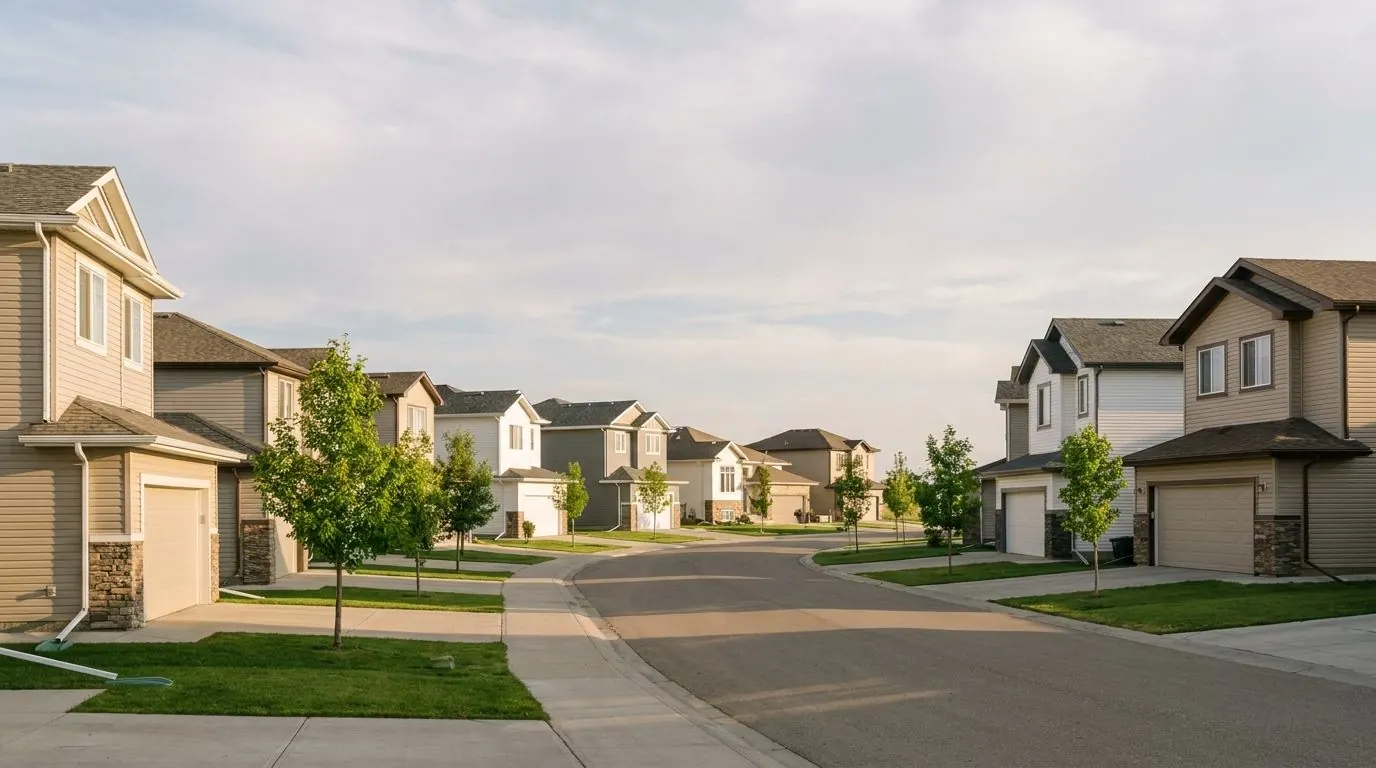
Growth since the 2010s in Kings Heights, Ravenswood, Midtown, Prairie Springs and Windsong commonly brought narrower lots, laned homes with rear garages, duplexes and townhome rows. Side yards can be barely wide enough to walk, so a downspout on the side of the house has nowhere obvious to send its water except toward the neighbour, which the City's drainage bylaw does not allow. Rear-yard swales carry lot drainage between houses, and a downspout discharging too close to one pushes water where the grading was never meant to take it. Anywhere in Airdrie, eavestroughs, downspouts and vinyl soffit replaced in the rush after a big hailstorm such as June 2020 deserve a careful second look at hangers, slope and corner seals.
Neighbourhood Notes
Coopers Crossing
Coopers Crossing is largely 2000s and 2010s construction, with two-storey homes whose valleys drop a lot of water into single inside corners. Corner mitres of that age are where original sealant commonly lets go, so corner re-sealing and a check for overflow at the valley are sensible first steps. Where a valley corner overflows every storm, a 6-inch trough on that run fixes the cause rather than the symptom.
Kings Heights
Kings Heights is 2010s-onward growth with tight side yards and front-attached garages. Downspouts on the side of houses like these commonly point at the neighbour or a shared walkway, which the City's drainage bylaw does not allow. We re-route those drops toward the front or back yard with flip-up extensions or a short run to a proper discharge point.
Bayside
Bayside's 2000s and 2010s homes sit on engineered lots, typically with swales and grading designed to carry runoff to the storm system. A downspout ending too near a swale overloads the grading, and one aimed at a lower neighbouring lot creates a dispute. Correctly placed extensions, at least two metres from the swale, keep the water on your side of the line.
Midtown
Midtown is 2010s-onward growth that includes denser housing forms. Where a home has a detached rear garage, that garage commonly has its own short eavestrough and downspout that is easy to forget, draining straight onto the lane or the path to the back door. We fit garages with a proper trough, a flip-up extension away from walkways, and guards where cleaning is awkward.
Hillcrest
Hillcrest holds some of Airdrie's older homes, where mature trees, painted wood fascia and eavestroughs still hung on spikes are common. Sag, pulled spikes and soft fascia behind the gutter are the common findings. We replace rotted boards first, then cap the fascia in aluminum and hang new seamless troughs on hidden hangers screwed into solid wood.
Woodside
Woodside grew around the golf course through the 1990s and 2000s, and it has more mature trees than newer areas, dropping leaves and seeds into the troughs every fall. Blocked outlets back water up until it freezes solid in a chinook cycle. Micro-mesh guards, or a scheduled spring and fall clean with downspout flushing, keep those runs open.
Prairie Springs
Prairie Springs is 2010s-onward construction on open ground with young landscaping, so the debris in its gutters is shingle granules, windblown dirt and seed fluff rather than leaves. The bigger issue is exposure: wind-driven hail and snow on open lots. Heavier .032" coil and perforated aluminum guards hold up better here than standard builder troughs.
Canals
The Canals area is mostly 2000s and 2010s housing. Where a yard has no room for a surface extension, buried downspout lines and pop-up emitters are a common answer, and they can freeze shut in winter. We add a winter overflow near the downspout and make sure every line slopes continuously with nowhere for water to sit.
Ravenswood
Ravenswood is one of Airdrie's newer neighbourhoods, where two-storey homes commonly have upper-roof downspouts discharging onto a lower garage or porch roof. That concentrated stream wears granules off the shingles and overshoots the lower eavestrough in a downpour. A splash shoe, or an extension carrying the water to the lower trough, stops the wear.
Old Town
Old Town around the city centre has Airdrie's oldest mix of houses and small commercial buildings, commonly re-roofed over the years without drip edge. Water wicks behind the eavestrough, staining and rotting the fascia and the roof deck edge. Retrofit drip edge, fitted in warm weather so cold shingles don't crack, sends that water into the trough where it belongs.
Big Springs
Big Springs has older homes from Airdrie's early growth, where soffit vents that are painted over, blocked by insulation or cracked are a common finding. A starved attic runs warm and feeds the ice dams that build along the eaves after a chinook. We replace soffit with vented aluminum and check that the attic baffles actually let the air through.
Luxstone
Luxstone is largely 2000s and 2010s housing, now at the age when first-generation corner seals and end caps start to drip. Hail-dented runs that were patched rather than replaced are worth checking too. We assess whether re-sealing will last or whether a dented run holding standing water should come down.
Permits and Drainage Rules in Airdrie
Authority having jurisdiction: City of Airdrie
The City of Airdrie is the authority here. Replacing eavestroughs, soffit or fascia on an existing house generally does not need a building permit, while a re-roof, structural rafter-tail work or commercial work may, so check with the City before assuming either way. Under the City of Airdrie's Drainage Bylaw B-03/2014 and Community Standards Bylaw, downspouts, eavestroughs and sump discharges must not discharge onto an adjacent property, must not empty onto external stairs, landings or walkways, and must direct water away from the building. The City also asks that downspouts sit at least two metres from a swale and not end less than two metres from your property line. Roof water never goes into the sanitary sewer. We lay out every extension and discharge point with those limits in mind.
What Airdrie Homes and Buildings Need Most
Airdrie Hail & Storm Damage Replacement
Hail-dented eavestroughs documented for your claim and replaced in heavier coil.
5-Inch Continuous Aluminum Eavestroughs
Continuous 5" K-style aluminum gutters formed on site in matched colours.
Flip-Up Downspout Extensions
Hinged extensions that carry roof water about 2 m out and lift for mowing.
Winter Ice Dam & Attic Frost Mitigation
Roof-edge and eavestrough fixes for ice dams, with honest attic heat-loss advice.
Corner Joint Re-Sealing & Leak Repair
Leaking corners, end caps and outlets stripped, re-sealed, riveted and water-tested.
Vented & Solid Aluminum Soffit Installation
Vented and solid aluminum soffit that restores attic intake and keeps pests out.
Close to Airdrie
Warehouses, commercial bays and acreage homes just south of Airdrie.
Small-town homes, shops and farmyards north of Airdrie on Highway 2.
Evanston, Sage Hill, Panorama Hills, Coventry Hills, Livingston and nearby.
Acreage homes, shops and farm buildings on the rural land surrounding Airdrie.
Eavestroughs in Airdrie: Questions
My Airdrie side yard is very narrow. Where is my downspout allowed to drain?
Our eavestroughs were replaced after the 2020 hailstorm. Why are they dripping or holding water already?
Why does ice build up in our eavestroughs in the middle of an Airdrie winter?
Eavestrough Work in Airdrie?
Call or send the details. Airdrie Gutters works from Airdrie, and we will tell you what the roof edge needs before we price it.