Hail Damage Eavestrough Inspection & Replacement in Airdrie
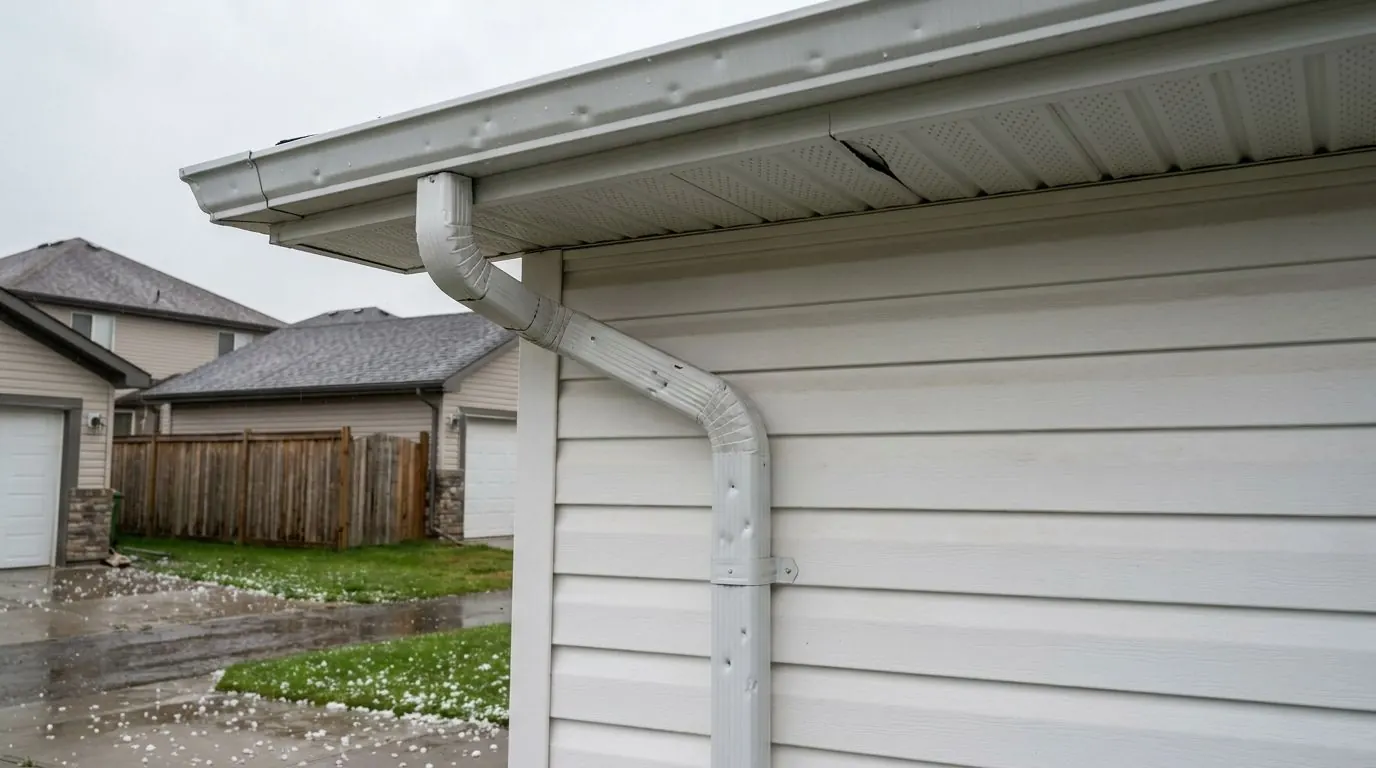
Hail dents eavestroughs, crushes downspouts and splits corner seals, and most of that damage is invisible from the driveway. We inspect every run, document it with photos and measurements for your insurance claim, and replace damaged troughs in heavier .032" seamless aluminum.
The Problem It Solves
On 13 June 2020 a hailstorm hit northeast Calgary, Airdrie and Rocky View County hardest and left more than a billion dollars in insured damage behind it. At the time it was the costliest hailstorm in Canadian history, with hail reported as big as tennis balls shredding vinyl siding. Most people remember the siding, the shingles and the smashed windshields. Far fewer remember to look up at the eavestroughs, soffit and fascia, which take the same beating from the same angle, from hail and from the high winds that often travel with it, and are often the last item anyone checks once the obvious repairs are underway.
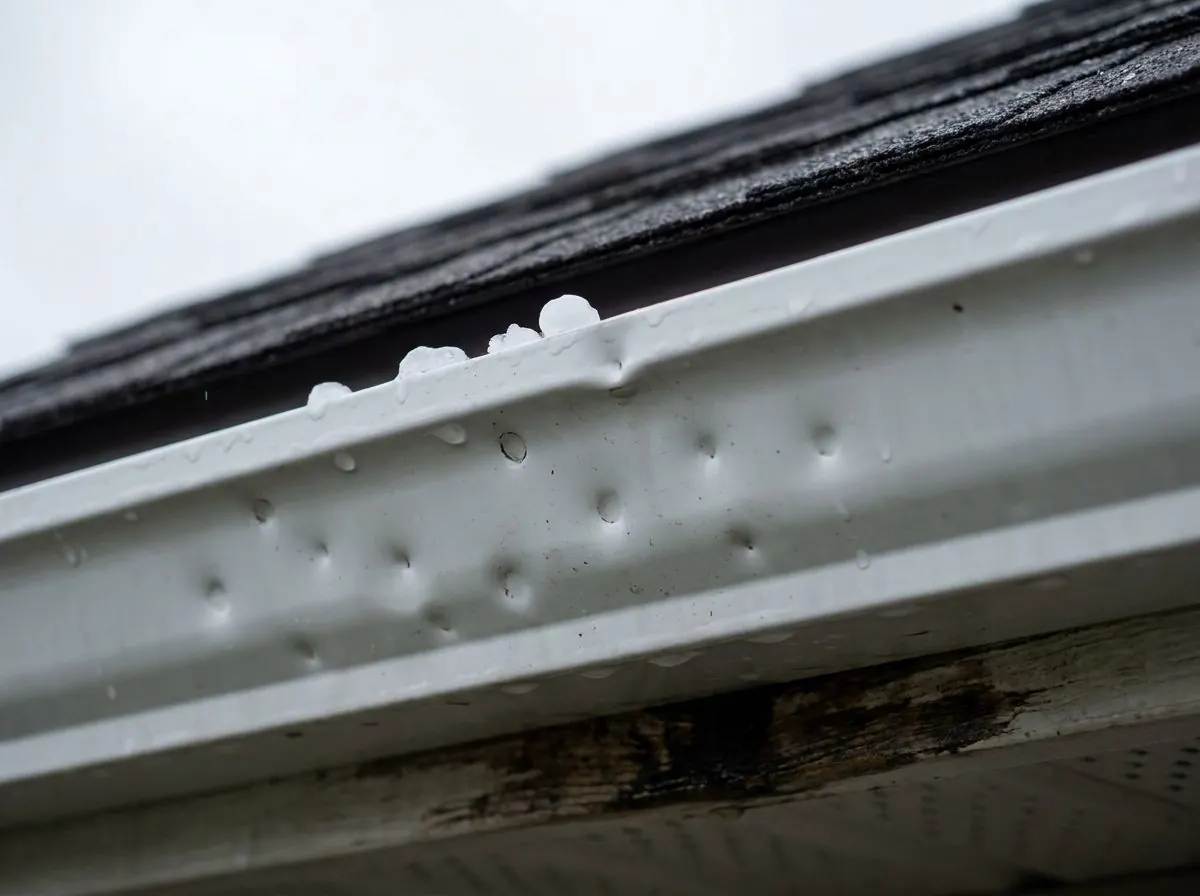
Hail damage on a gutter is rarely dramatic. A thin .027" aluminum trough takes a row of shallow dents along its front face and top lip, a downspout gets crushed at an elbow, and a corner mitre that was already stiff with age takes one hard strike and cracks its sealant. From the ground the system still looks like an eavestrough. The trouble shows up later: water sits in dented low spots, freezes, and adds weight; a flattened downspout backs up and overflows at the outlet; a split corner starts dripping onto the same patch of fascia every time it rains.
The second problem is timing. Hail claims have documentation requirements and time expectations that sit in your policy, and damage that nobody recorded right after a storm is harder to connect to that storm months later. Meanwhile the Calgary–Airdrie corridor is one of the most hail-prone areas in Canada, so a house can be hit again the next summer. When eavestroughs are replaced in a rush without anyone asking why they dented so easily, homeowners often end up with the same light coil that failed the first time, waiting for the next June.
How It Works
We start with evidence, not a sales pitch. A hail inspection covers every run from the roof edge and the ladder, not just from the lawn, because the dents that matter are on the top lip and the inside face where you cannot see them. We check each corner mitre, end cap and outlet, look at every downspout for crushing and kinks, and note damage to vinyl soffit and aluminum fascia capping at the same time, because hail rarely hits one component of the roof edge and spares the one beside it.
Then we write it down in a form an adjuster can read. You get dated photos organized by elevation, the location of dented sections, run lengths, corner and downspout counts, and plain notes on what is cosmetic and what affects how water moves. That record is yours to send to your insurer. We are clear about our role: the insurer and adjuster decide what your policy covers and how much. We do not promise coverage, we do not tell you what a claim will pay, and we never describe any of this work as costing you nothing.
When replacement of hail- or wind-damaged eavestroughs, soffit or fascia goes ahead, we do not simply copy what was there. Troughs are roll-formed on site from pre-painted coil into one continuous length per run, and on most hail jobs we recommend stepping up from .027" to .032" heavy-gauge aluminum, which resists denting from hail, ladders and snow load noticeably better. We check whether the roof really needs 5" or 6" troughs, hang the new system on hidden hangers 12–18" apart into solid wood, and re-set the downspouts so the water still leaves the foundation the way the City of Airdrie expects.
How the Job Runs, Step by Step
Post-storm roof-edge inspection
We walk the full perimeter, then go up to the eave line with a ladder to see the top lip and inside face of every run. Each corner, end cap, outlet and downspout is checked by hand. Soffit and fascia damage along the same edge is noted so nothing is missed in the claim.
Photo and measurement record
Every dented section is photographed with a reference for scale and tied to its elevation and run. We measure run lengths and count corners, outlets and downspouts. The record is dated and handed to you so you can send it to your insurer and adjuster as you see fit.
Repair-or-replace assessment
Some storms leave a single crushed downspout that can be swapped on its own. Others dent every run on the windward side. We tell you plainly which you have and why, including where a dent is purely cosmetic and where it holds water or has broken a seal.
Specify the replacement system
We confirm trough size against roof area, pitch and valleys, recommend coil thickness, match or change the colour, and decide whether downspouts stay 2x3" or step up. If vinyl soffit or fascia capping also needs replacing, we sequence that work before the new eavestroughs go on.
Tear-off, forming and hanging
Damaged troughs and downspouts come off and are hauled away. We check the fascia behind them for soft wood, form new seamless runs on site, hang them on hidden hangers into solid wood, set the fall to the outlets, seal corners, and water-test before we leave.
What Decides the Specification
Coil thickness is the decision that matters most on a hail job. Standard .027" aluminum is perfectly serviceable on a sheltered house, but it dents readily under large stones. Heavy-gauge .032" is stiffer, holds its shape under hail and ladder weight better, and carries winter ice load with less flex at the hangers. It will not make an eavestrough hail-proof; very large hail can still mark it. It does move the line at which a storm turns into a replacement. Colour is baked on at the coil stage, so we match your fascia and soffit, or you can use the replacement as the moment to change it.
Size and layout come next. Many homes had 5" troughs installed as a default, and that suits most roofs. If a large or steep roof, a long run or a valley dumping into one corner was overflowing before the storm, a replacement is the sensible time to move to 6" troughs with 3x4" downspouts rather than rebuilding a system that was already undersized. Guards are a separate choice: stiff perforated aluminum covers stand up to hail better than soft screens, and we can talk through that option once the replacement is specified.
Code, Bylaw and Manufacturer Notes
Replacing eavestroughs, soffit or fascia on an existing house in Alberta generally does not need a building permit (Alberta builds to the National Building Code – 2020 Alberta Edition), but a re-roof, structural fascia or rafter-tail work, or commercial work may. Rules are set locally, so check with the City of Airdrie, Rocky View County or the City of Calgary for your address. If your shingles are also being replaced after the storm, that is roofing work, and the eave protection membrane and drip edge are the roofer's to install before our new troughs go on.
New downspouts still have to follow the City of Airdrie's drainage bylaw (B-03/2014 and the Community Standards Bylaw): discharge away from the building, not onto a neighbour's property, stairs, landings or walkways, at least two metres from a swale and not ending less than two metres from your property line. Downspouts never tie into the sanitary sewer. Insurance terms are not code: what your policy covers, what it requires you to document and by when, are set by your insurer, so read your policy and ask your adjuster.
General guidance only. The municipality, its bylaws and the manufacturer’s installation instructions decide what applies to your job.
Around Airdrie
The 2020 storm hit northeast Calgary, Airdrie and Rocky View County hardest. Coopers Crossing and Bayside, largely built through the 2000s and 2010s, are typical of housing that commonly went up with vinyl soffit and standard-gauge seamless eavestroughs, a sensible package in ordinary weather and a vulnerable one in large hail. After a big storm it is common to find a house that had its siding and shingles redone after a storm while the dented troughs above were left in place, still holding water in the low spots and dripping at corners that cracked the same day.
The exposure is not limited to one storm or one town. Hail season runs roughly June to August through the whole corridor, and the open prairie around Balzac, Crossfield, Irricana and the acreages of Rocky View County gives storms nothing to slow them down. The same pattern holds in north Calgary: it is common for the elevations facing into a storm to be dented while the sheltered side is untouched. That is why our inspection records each elevation separately, and why we lean toward .032" coil for replacements in this part of Alberta.
Often Done Alongside
5-Inch Continuous Aluminum Eavestroughs
Continuous 5" K-style aluminum gutters formed on site in matched colours.
Vented & Solid Aluminum Soffit Installation
Vented and solid aluminum soffit that restores attic intake and keeps pests out.
Perforated Aluminum Screen Guards
Stiff punched-aluminum covers that shed big leaves and stand up to hail.
Where We Do This Work
Hail & Storm Damage: Questions We Get
Will my insurance pay for new eavestroughs after hail?
Is heavier .032" aluminum actually worth it here?
How can I tell whether my eavestroughs were damaged?
Can hail-damaged gutters be repaired instead of replaced?
Do I need a permit to replace eavestroughs, soffit or fascia?
Considering Hail & Storm Damage?
Call Airdrie Gutters or send the details. We will look at the job, tell you whether hail & storm damage is the right fix, and price it in writing.