Perforated Aluminum Gutter Covers for Airdrie Hail Country and Acreage Leaves
Rigid punched-aluminum covers that screw or snap onto your eavestroughs, built to take hail, a leaning ladder and a load of wet poplar leaves without folding into the trough. A practical guard for exposed new subdivisions and shelterbelt acreages around Airdrie and Balzac.
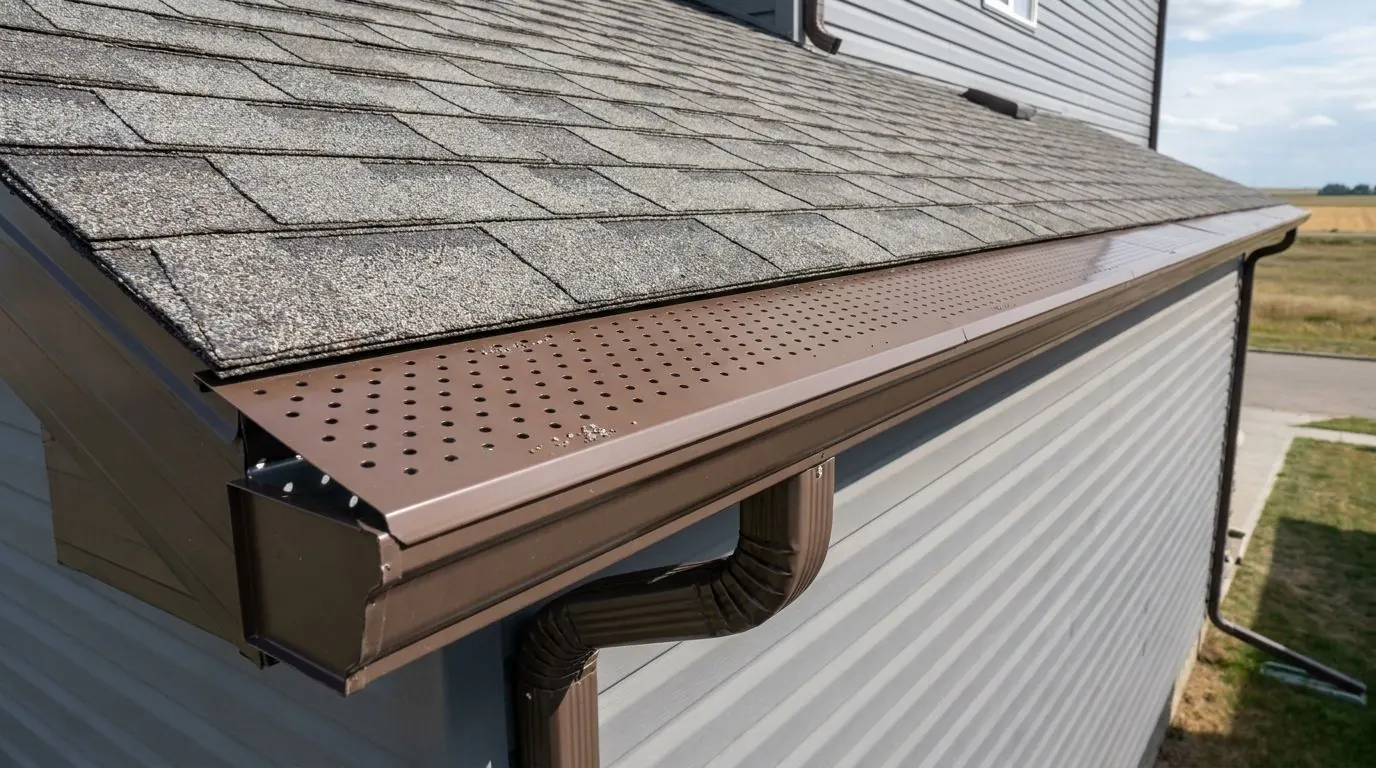
The Problem It Solves
Big leaves behave differently from needles. A poplar or aspen leaf lands flat, soaks up water and seals over the downspout outlet like a lid. On an acreage with a shelterbelt along the yard, a single October wind can fill a run of eavestrough from end to end in an afternoon, and the next rain turns that layer into a heavy, wet compost. The trough overflows at the low end, the hangers take weight they were never meant to carry, and the downspout below stays dry while water pours over the lip beside it.
Hail is the other half of the problem around Airdrie. The Calgary–Airdrie corridor is one of the most hail-prone areas in Canada, and the storm season runs roughly June through August. Thin wire screens and flimsy plastic inserts dent, crack or pop loose when hailstones hit them, then sag into the trough and hold debris instead of shedding it. A guard that is damaged in the first summer storm ends up costing more than an open gutter, because now someone has to remove the broken screen before they can even clean the trough.
There is also the everyday abuse a gutter cover takes. Window cleaners, painters, holiday-light installers and homeowners lean ladders against the eaves. Soft or fine screens crush under that point load and never sit flat again, opening gaps where leaves slip under the edge. On exposed prairie lots, wind drives dust, seed heads and small twigs along the roof and into any gap it finds. A cover that cannot take a knock, a ladder rail or a gust will not keep doing its job for long.
How It Works
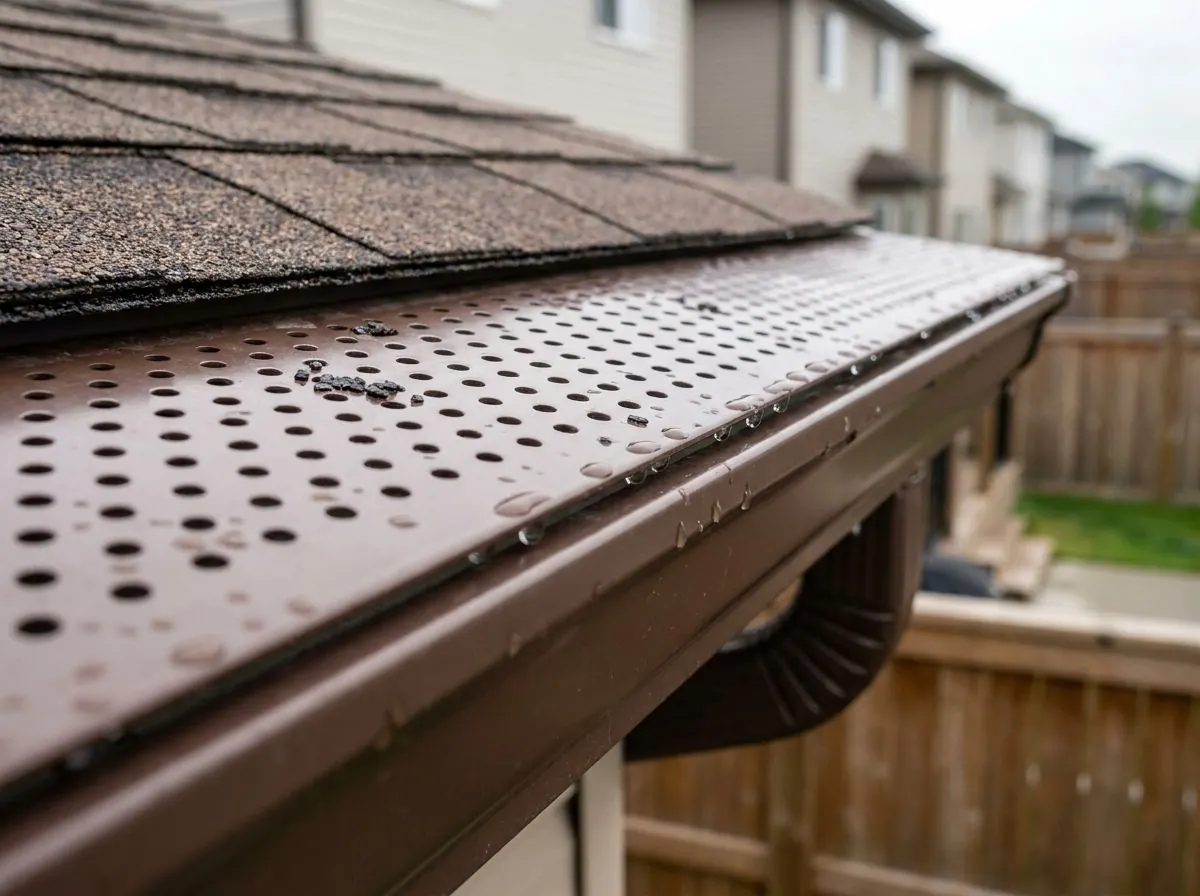
A perforated aluminum cover is a stiff sheet of prefinished aluminum punched with rows of small holes, formed to span the top of the eavestrough. Rainwater runs down the shingles, crosses the cover and drops through the perforations into the trough. Leaves, catkins, twigs and seed heads are too large to pass through, so they sit on the smooth surface until they dry and blow off. Because the cover is solid metal between the holes rather than a woven screen, it holds its shape under a wet leaf layer and does not bow into the gutter.
That stiffness is why we recommend perforated covers where hail and physical contact are the main risks. The sheet spreads the force of a hailstone or a ladder rail across a wider area rather than letting a single wire strand take it. We fasten covers either with screws through the front edge into the gutter lip, which holds them tightly against wind and ice, or with a snap-in fit into the trough where the manufacturer's system and the house suit it. On exposed lots and long, windy runs, screw-in attachment is usually our choice because it keeps covers from lifting.
What you get is an eavestrough that keeps draining through leaf season without a ladder clean-out every fall, and a cover that is still flat and fastened after the summer's storms. We are clear about the trade-off: perforations are larger than a micro-mesh opening, so fine shingle granules and grit still reach the trough. On most houses that means a light flush of the troughs and downspouts from time to time instead of shovelling out wet leaves. Like any guard, a perforated cover does not stop snow or ice from resting on top in winter.
How the Job Runs, Step by Step
Match the debris to the cover
We look at the trees on and around the lot, from shelterbelt poplars to yard maples, and at how much fine granule wash is coming off the roof. If fine debris dominates, we say so and point you toward mesh; if leaves, twigs and hail exposure dominate, perforated covers are the fit.
Assess the gutter for hail damage
Covers are fastened to the trough, so the trough has to be sound. We check runs for dents, crushed corners, split sealant at mitres and flattened downspouts from past storms. Minor dents that do not hold water can stay; badly damaged runs are better replaced before a cover goes on.
Clear leaves and flush
We remove the accumulated leaf mat and compost by hand, flush each run and downspout, and confirm water leaves every outlet. On acreage buildings with long runs, this is also when we check that the fall toward each outlet still works after years of heavy leaf loads.
Choose screw-in or snap-in and fasten
Based on exposure, gutter profile and the manufacturer's system, we fasten covers with screws along the front lip or snap them into the trough. Sections are overlapped or joined so no leaf can slide between them, and the back edge is set without lifting, cracking or nailing through shingles.
Trim corners and test the flow
Inside and outside corners are cut and fitted so the cover stays continuous at mitres, where leaves otherwise pile up. We then run water down the roof above each run, including valleys, and watch that it drops through the perforations and exits the downspouts rather than skating off the front edge.
What Decides the Specification
Exposure drives the attachment method. On a sheltered suburban eave, a snap-in cover can sit securely and comes out easily for inspection. On a wide-open acreage or a new subdivision lot where wind comes across the prairie with nothing to break it, screw-in covers fastened to the gutter lip are the safer choice, because a cover that lifts in a gust lets leaves under and can end up in the yard. The cover width must match the trough, so a 6" eavestrough takes a 6" cover; we do not bend a narrow cover to fit a wider gutter.
The condition and gauge of the eavestrough decide how well a cover performs over time. Covers add stiffness to the top of the trough, but they rely on the gutter and its hangers for support, so a heavy-gauge .032" trough on closely spaced hidden hangers gives a much sturdier base than a thin .027" trough spiked into the fascia. The size of the leaf load matters too: under a dense shelterbelt, we pay particular attention to valleys and to the run ends nearest the trees, where dry leaves collect on the cover and may need clearing from time to time.
Code, Bylaw and Manufacturer Notes
Fitting covers to existing eavestroughs is generally considered maintenance and does not usually call for a building permit, but check with the City of Airdrie, Rocky View County or your own municipality if the work is part of a larger exterior project. On acreages in Rocky View County, drainage expectations are set by the County rather than the City, so check with the County on where roof water may discharge. Inside Airdrie, the City of Airdrie's drainage bylaw (B-03/2014) asks that downspouts not discharge onto neighbouring property and sit at least two metres from a swale.
Manufacturer instructions govern the rest. Cover makers specify whether their product fastens to the front lip, snaps into the trough, or tucks under the first shingle course, and some shingle manufacturers are careful about anything that lifts or penetrates that course, which can matter for a shingle warranty. We use the cover manufacturer's fastening method, keep screws out of the shingles, and leave the drip edge and eave protection membrane untouched.
General guidance only. The municipality, its bylaws and the manufacturer’s installation instructions decide what applies to your job.
Around Airdrie
Kings Heights is a good example of where perforated covers earn their place. It is one of Airdrie's newer neighbourhoods, built from the 2010s onward on open ground with young trees, so the debris is not needles but windblown leaves, seed heads and dirt carried across open lots. What those roofs do see is hail. The 13 June 2020 storm hit northeast Calgary, Airdrie and Rocky View County hardest and caused more than a billion dollars in insured damage, and a storm of that size shows how easily light materials dent and tear. A stiff aluminum cover is built for that kind of summer.
South toward Balzac, and across the Rocky View County acreages around Airdrie, the picture is shelterbelts: long rows of poplar and aspen planted as windbreaks along yards and driveways. Those trees drop large leaves and cottony catkins onto house roofs, shops and garages every year, often more than a homeowner can keep up with on long eaves. Perforated covers shed that debris and put up with the ladder traffic that comes with maintaining outbuildings. The same approach suits acreages near Crossfield and Irricana, where exposure to wind is just as high.
Often Done Alongside
Micro-Mesh Gutter Guards
Stainless mesh guards that stop needles, seeds and shingle grit at the gutter.
Airdrie Hail & Storm Damage Replacement
Hail-dented eavestroughs documented for your claim and replaced in heavier coil.
Gutter Cleaning & Downspout Flushing
Hand-scooped troughs, flushed downspouts, augered elbows and a written report.
Where We Do This Work
Perforated Guards: Questions We Get
Will perforated covers survive a hailstorm?
Can I still lean a ladder against my eavestroughs with covers on?
Screw-in or snap-in: which attachment should I pick?
How often will I still need to clean gutters with perforated covers?
Do I need a permit to replace eavestroughs, soffit or fascia?
Considering Perforated Guards?
Call Airdrie Gutters or send the details. We will look at the job, tell you whether perforated guards is the right fix, and price it in writing.