Stainless Micro-Mesh Gutter Guards for Airdrie Homes Under Spruce and Pine
Fine stainless-steel mesh on a rigid aluminum frame, fitted to your 5" or 6" eavestroughs so spruce needles, seeds and shingle granules stay on top and rain drops through. Built for the older, treed streets of Airdrie, with an honest account of what a guard can and cannot do in winter.
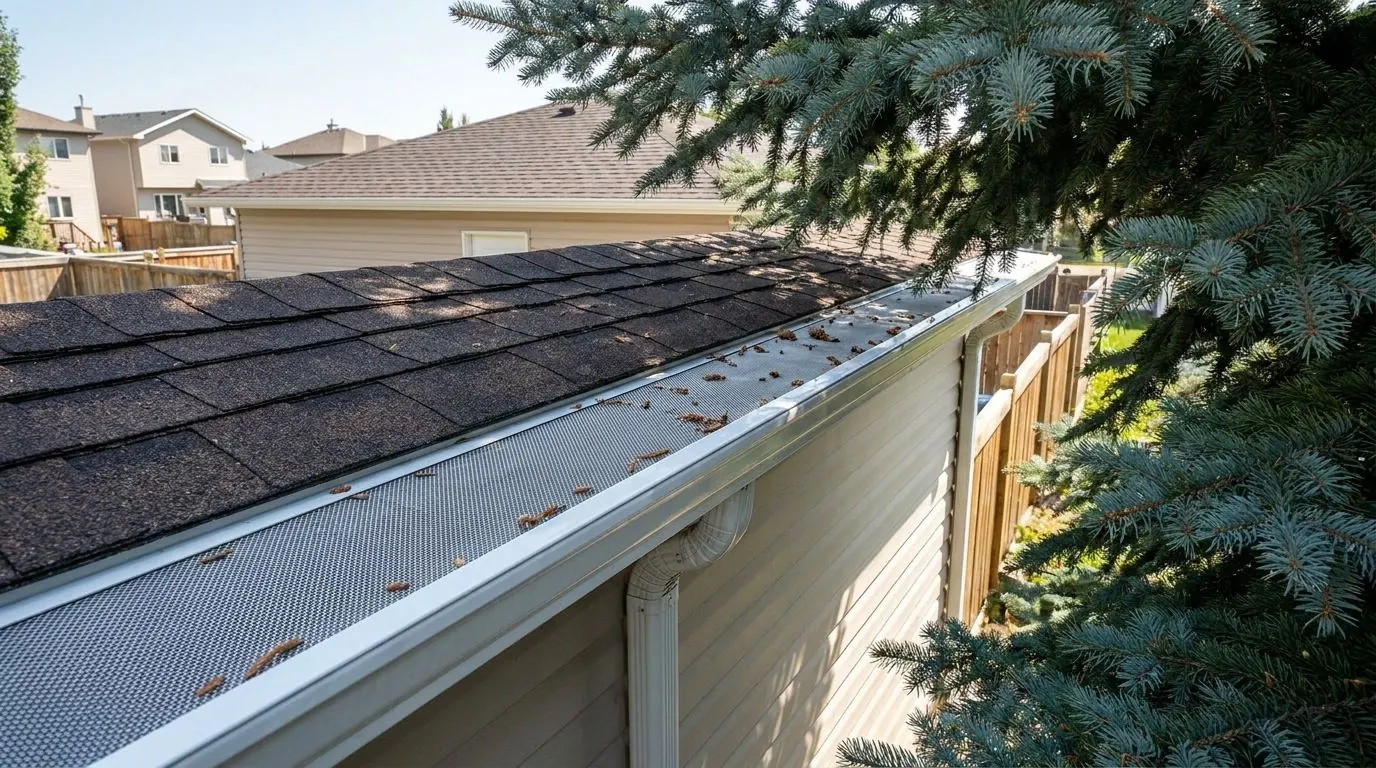
The Problem It Solves
An open eavestrough under a mature spruce collects needles the way a sieve collects sand. Spruce and pine needles are short, stiff and slow to rot, so they knit together into a mat at the bottom of the trough and wrap around the downspout outlet. Leaf screens with large openings do little against them because a needle is thin enough to slide straight through. Within a season or two the outlet is choked, the trough holds a few centimetres of standing water, and every rain after that runs over the front lip instead of down the downspout.
The overflow is the expensive part. Water that spills over the lip lands in a line along the foundation, and on Airdrie's clay-rich soils it does not soak away quickly; it follows the backfill down the wall toward the basement. The standing water left in a blocked trough adds weight to every hanger, keeps sealant at the mitres and end caps wet, and turns into a solid block of ice the first cold night in October. A packed trough can also carry wet needles and grit back over the drip edge, where moisture sits against the fascia board.
The usual answer is a ladder twice a year, and for many owners that stops being realistic. Roofs over walkout basements are tall, back yards slope away, and a spring clean-out only buys a few months before seeds, fluff and a fresh drop of needles arrive. Meanwhile, even on a house with no big trees nearby, aging asphalt shingles shed granules that settle in the low points of the gutter like wet sand. That fine grit is the debris most homeowners never see from the ground, and it is exactly what a coarse screen lets through.
How It Works
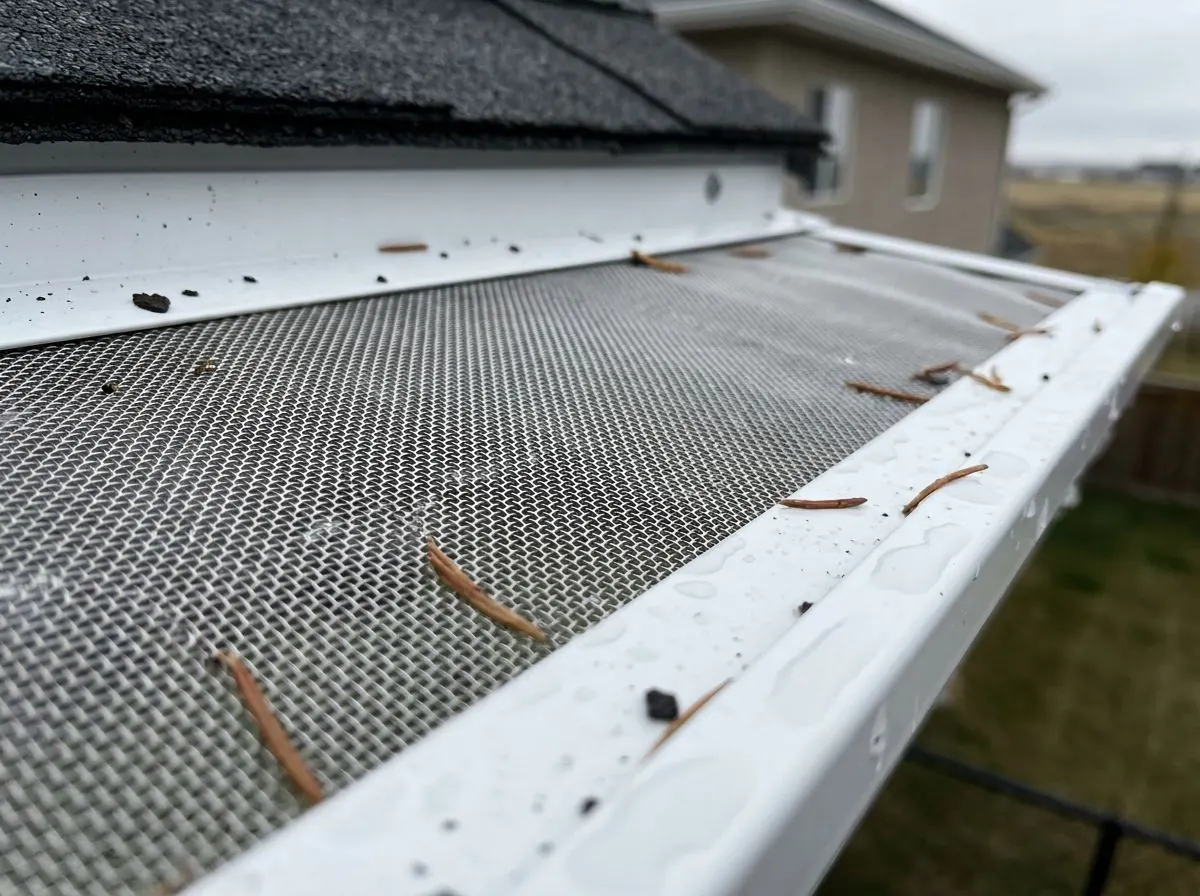
A micro-mesh guard puts a fine stainless-steel screen across the whole top of the eavestrough, held flat and taut by a rigid aluminum frame. Rain running off the shingles reaches the edge, clings to the mesh surface and drops through into the trough, while needles, seeds, fluff, most shingle granules and other small debris stay on top. Because the open area across the mesh is continuous rather than a few slots, a clean micro-mesh screen is a high-flow design that takes in roof water quickly in a heavy rain. And since the openings are far smaller than a needle's diameter, needles cannot thread through the way they do in a perforated or wire leaf screen. What lands on the mesh dries out, and wind and the next rain move most of it off the roof edge.
The frame matters as much as the mesh. A stiff aluminum frame keeps the screen from sagging into the trough under wet debris or a snow load, so water keeps a flat surface to cross rather than a dip where silt collects. We fit the back edge of the guard so it lies in the plane of the roof, tucked under the first shingle course or secured to the drip edge as the guard manufacturer directs, and fasten the front edge to the gutter lip. Done that way, the guard does not lift shingles, and water follows a continuous path from shingle to mesh to trough.
What you get is a gutter that stays open to its downspout without a twice-yearly clean-out, and a much smaller maintenance job: an occasional rinse of the mesh surface with a soft brush where pollen or a fine film has built up, and a look at the downspouts each season. We are straight about winter. Snow and ice can sit on top of any guard, including this one, and a guard does not stop an ice dam forming. It keeps the trough clear so that, when a chinook melts the roof, the meltwater has an open path to the downspout.
How the Job Runs, Step by Step
Debris and roof survey
We walk the eaves and look at what is actually landing in your gutters: spruce needles, poplar seeds, cottonwood fluff or shingle granules. We note which runs sit under trees, where valleys concentrate water, and how old and loose the shingles are at the first course, because brittle shingles change how we attach the back edge.
Clean out and flush the troughs
Guards go over a clean gutter, never over a packed one. We scoop out needles and silt by hand, flush each run and downspout with water, and confirm every outlet drains. Anything we find while the trough is open, such as a failed mitre or a pulled hanger, is pointed out before the mesh covers it.
Check slope, hangers and outlets
A guard cannot fix a trough that holds water. We check that each run falls toward its outlet and that hangers are tight into solid wood, so the gutter can carry the extra weight of wet debris or snow resting on the mesh. Low spots and loose hangers are corrected first, or flagged if they need separate repair.
Cut, fit and fasten the mesh panels
Panels are cut to length on site, fitted around inside and outside corners, and overlapped or joined per the manufacturer so no gap opens at a mitre. The back edge is set in the roof plane without prying up or cracking shingles, and the front edge is fastened to the gutter lip so wind cannot lift it.
Water test and handover
We run water onto the roof above the guarded runs and watch it cross the mesh and exit at every downspout, paying close attention to valleys where flow is heaviest. You get a short walk-through of the rinse routine, what to watch for in winter, and which runs, if any, would benefit from a second look after the first autumn needle drop.
What Decides the Specification
The main decision is debris type. Where the problem is conifer needles, shingle granules or fine seeds, a fine stainless mesh is the right screen, because those particles pass straight through wider openings. Where the problem is large deciduous leaves and hail exposure with little fine debris, a stiffer perforated aluminum cover can be the more practical choice; that comparison belongs on its own page. Stainless is used for the screen because it does not rust in standing moisture and holds its weave through repeated freezing, and aluminum is used for the frame so it is compatible with aluminum eavestroughs and does not sag under a wet load.
Gutter size and condition drive the rest. Guards are made to span 5" and 6" K-style troughs, so we match the frame width to what is on the house. A heavy-gauge .032" trough on solid hidden hangers is a good base for a guard; a thin, dented or sagging trough is not, and it is often better to replace or re-hang the run first. Roof pitch also matters: on a steep roof, water moves fast across a narrow mesh surface, so we look at valleys and short, steep runs closely and choose a profile that keeps water on the screen rather than letting it skip past the front edge.
Code, Bylaw and Manufacturer Notes
Adding a gutter guard to existing eavestroughs is generally treated as maintenance rather than work that needs a building permit, but rules vary, so if you are part of a larger re-roof or exterior renovation, check with the City of Airdrie or your municipality. The guard does not change where your downspouts discharge; the City of Airdrie's drainage bylaw (B-03/2014) still expects roof water to be directed away from the building, not onto a neighbouring lot, and not closer than two metres to a swale or to your property line.
The more practical rule set is the manufacturers'. Guard makers specify how the back edge attaches, and some shingle manufacturers are particular about anything fastened through or lifting the first course, which can matter to a shingle warranty. We follow the guard manufacturer's attachment method, avoid nailing through shingles, and leave the eave protection membrane and drip edge undisturbed. If your roof is close to replacement, it is usually worth installing guards after the new roof so the attachment suits the new shingles.
General guidance only. The municipality, its bylaws and the manufacturer’s installation instructions decide what applies to your job.
Around Airdrie
Most of Airdrie's newer subdivisions have young trees and little canopy, so their eavestroughs fill with granules, seeds and windblown dirt rather than leaves. Woodside is different. It grew up around the golf course through the 1990s and 2000s, and it holds more mature trees than Airdrie's newer subdivisions, including spruce near established landscaping. Spruce drop needles through the year, not just in fall, which is why downspout outlets under them can pack up even after a spring clean-out. Micro-mesh is built for that exact debris, and it catches the shingle granules coming off roofs that are reaching the end of their first life.
Hillcrest, along with Old Town and Big Springs, holds some of Airdrie's older homes, with mature trees and roofs that have been through many hail seasons and chinook winters. On those houses, fine grit from worn shingles is often as much of a problem as needles, and gutters and hangers may be original. We look at the whole edge before we recommend mesh there. Across the rest of our service area, acreages in Rocky View County and older yards in Crossfield and Cochrane with shelterbelt conifers show the same pattern and benefit from the same fine screen.
Often Done Alongside
Perforated Aluminum Screen Guards
Stiff punched-aluminum covers that shed big leaves and stand up to hail.
Gutter Cleaning & Downspout Flushing
Hand-scooped troughs, flushed downspouts, augered elbows and a written report.
Winter Ice Dam & Attic Frost Mitigation
Roof-edge and eavestrough fixes for ice dams, with honest attic heat-loss advice.
Where We Do This Work
Micro-Mesh Guards: Questions We Get
Will micro-mesh keep spruce needles out of my eavestroughs?
Do micro-mesh guards need any maintenance at all?
Can water overshoot the mesh in a heavy summer downpour?
What happens to micro-mesh gutter guards in an Airdrie winter?
Can eavestroughs be installed in an Airdrie winter?
Considering Micro-Mesh Guards?
Call Airdrie Gutters or send the details. We will look at the job, tell you whether micro-mesh guards is the right fix, and price it in writing.