Leaking Eavestrough Corner Repair & Re-Sealing in Airdrie
A dripping eavestrough corner is usually failed sealant, and caulking over the old bead rarely lasts a winter. We strip leaking mitres, end caps and outlets to bare metal, re-seal them with gutter-grade polymer sealant, rivet loose joints and water-test every repair.
The Problem It Solves
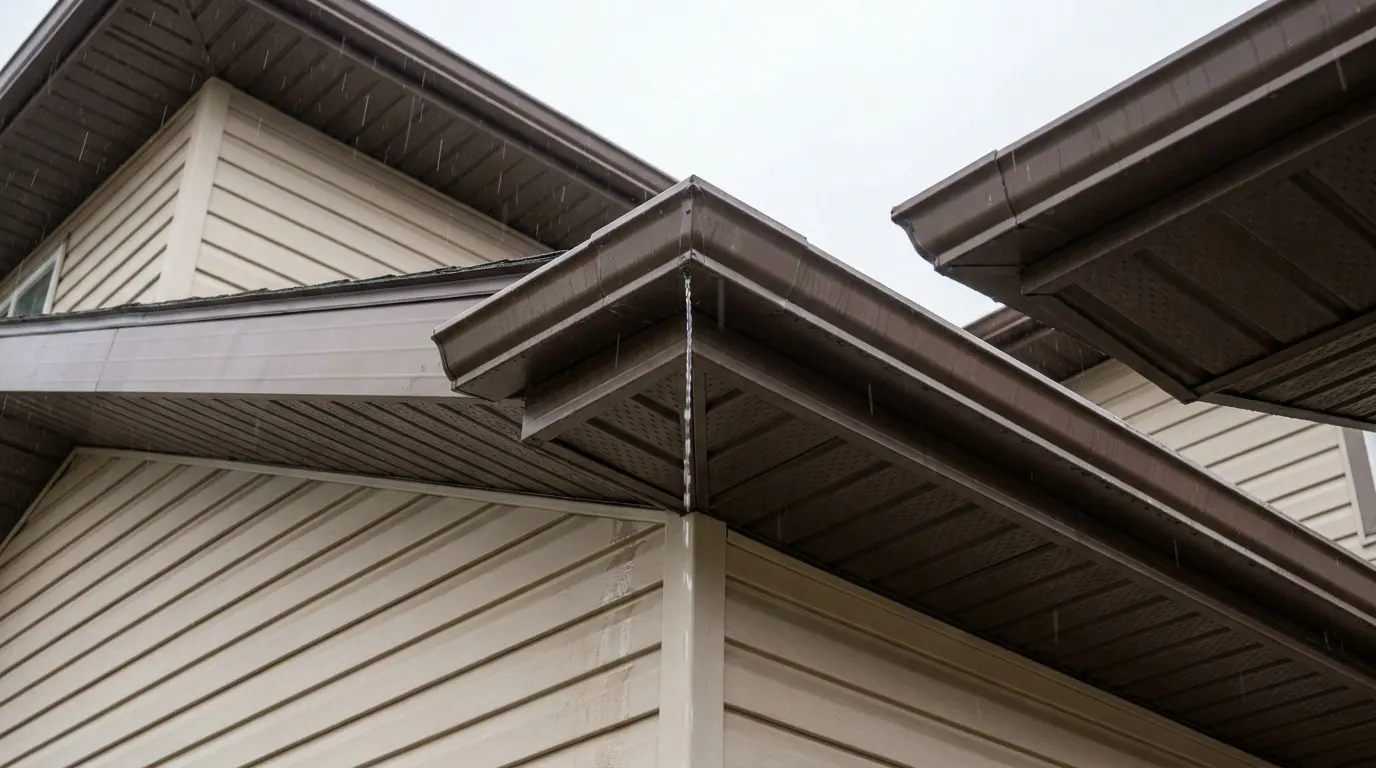
A seamless eavestrough is one continuous length per run, which means its only weak points are the places where pieces still meet: inside and outside corner mitres, end caps and the outlets where downspouts drop. Every one of those joints depends on a bead of sealant. When the eavestrough was new, that sealant was soft and bonded to clean metal. After years of Chinook thaws and hard refreezes, sun on the south side and aluminum expanding and shrinking through each temperature swing, it hardens, cracks along the edge and pulls away from the metal.
The leak that follows is small and patient. Water runs into the corner, finds the crack and drips onto the same spot of fascia, soffit or siding every time it rains or every afternoon that snow melts off the roof. In winter the drip freezes into an icicle and a patch of ice on the walkway below. Over a few seasons that steady wetting soaks into the fascia board behind the trough, stains siding, softens the wood the hanger screws rely on, and puts water right at the foundation next to the corner of the house.
It is common for a leaking corner to have been patched already, often with a tube of whatever caulk was in the garage, squeezed over the dirt, grit and old cracked sealant already in the joint. That patch has nothing clean to bond to. It looks sealed for a few weeks, then the first cold snap pulls it loose and the drip returns, often worse, because the new layer now traps water against the joint. It is not unusual for a corner to have been caulked two or three times with none of the layers doing any work.
How It Works
A durable corner repair is mostly preparation. We remove every trace of the old sealant from the joint, inside the trough and along the seams, using scrapers and brushes until the aluminum is bare. Oxidized, chalky sealant is stripped along with it, and the metal is cleaned of oxidation, granules and film, then dried completely, because sealant applied to damp or dirty metal does not bond no matter how good the product is. This is the step that separates a repair that lasts for years from one that is back before the snow melts.
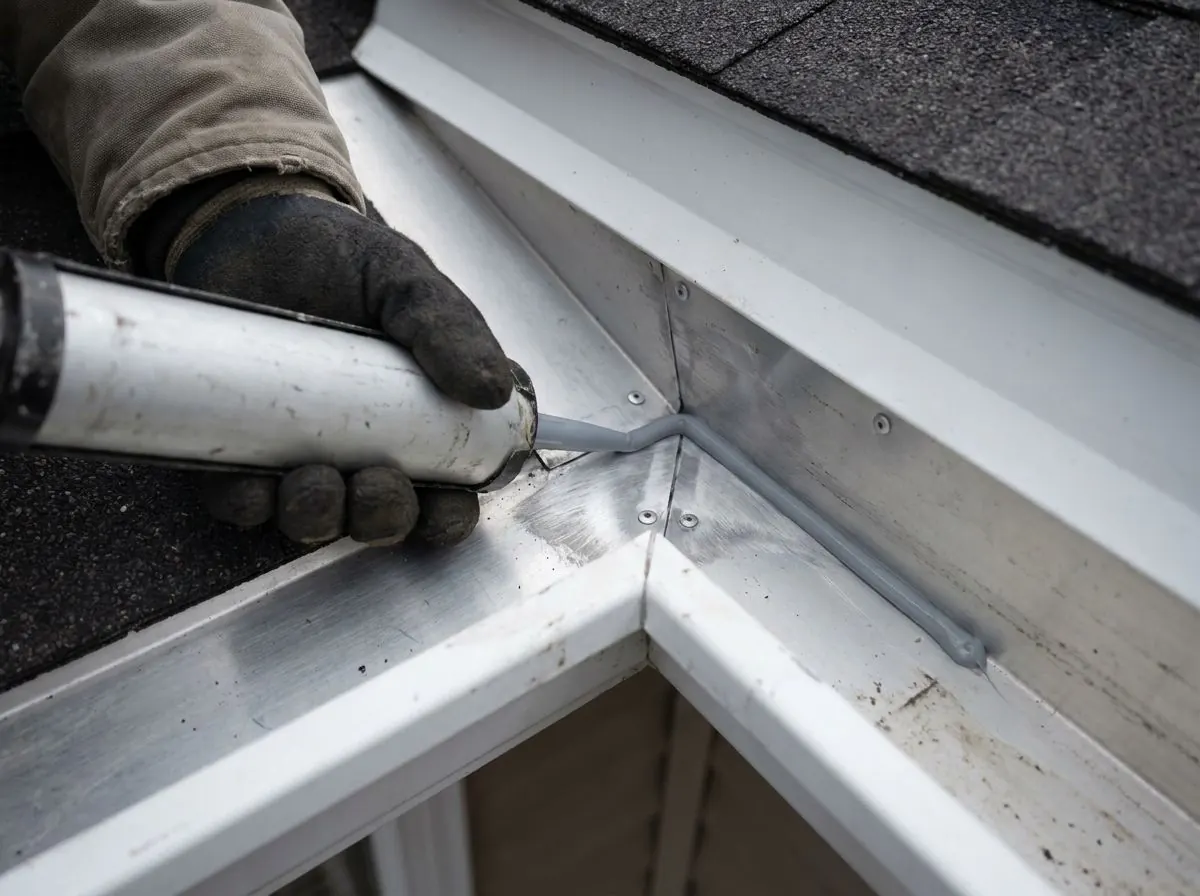
Once the joint is clean, we check how the pieces fit. A mitre or end cap that has worked loose gets new aluminum rivets to pull it tight, so the sealant is not being asked to hold the joint together as well as keep water out. Then we lay a gutter-grade polymer or elastomeric sealant into the seam from inside the trough, tooled so water flows over it rather than pooling against its edge. These sealants stay flexible in cold weather, which is what lets them ride through the freeze–thaw movement that cracked the old bead.
Outlet leaks get the same treatment with one addition: we check that the outlet is not partly blocked and that the trough actually falls toward it. A slow or clogged downspout keeps water sitting on the outlet seal far longer than it should. Every repaired joint is then water-tested with a hose before we pack up. If we find a leak we cannot honestly fix with sealant, such as a split in the metal, we show you and explain the options rather than burying it under another bead.
How the Job Runs, Step by Step
Trace each leak to its source
We run water into the trough and watch every corner, end cap and outlet from the ladder. Drips often travel along the back of the trough before falling, so the stain on the siding is not always under the failed joint. Each leaking joint is marked before we touch anything.
Strip old sealant to bare metal
Old caulk, cracked sealant and debris are scraped and brushed out of the seam completely. We keep going until only bare aluminum remains along the full joint. Partial removal leaves a weak edge where water gets back in.
Clean, dry and re-rivet
The joint is cleaned of oxidation and grit and allowed to dry. Loose mitres, end caps and outlets get new aluminum rivets to pull them tight. The joint then holds itself together mechanically, and the sealant only has to keep water out.
Apply gutter-grade sealant
A cold-flexible polymer or elastomeric sealant is laid into the seam from inside the trough and tooled smooth. We shape it so water runs across the joint, not along a ridge of sealant where it can sit and freeze.
Cure, water-test and report
After the sealant has set enough to test, each repaired joint is flooded with a hose and checked from below. We tell you which joints were repaired, anything we saw that sealant cannot fix, and whether any section is close to needing replacement.
What Decides the Specification
The sealant matters, but the choice is narrower than a hardware aisle suggests. General-purpose household caulks are not made for a gutter joint: many harden and crack in cold or do not stay bonded to aluminum through thermal movement. We use sealants made for gutters and metal roofing, polymer or elastomeric types that remain flexible well below freezing and are rated for standing water contact. Colour is secondary because the bead sits inside the trough, but we keep outside corners tidy where the joint is visible from the street.
What decides between a re-seal and a replacement is the metal, not the leak. If the aluminum at the joint is sound, the pieces can be riveted tight and the trough falls to its outlet, a proper re-seal is the right fix. If the corner metal is split, heavily corroded from years of pooled water, crushed by a ladder or hail, or if the whole run holds water because its slope has gone, sealant is only postponing the problem. Sagging runs and pitch correction are their own jobs, and we will point you to them when that is the real cause.
Code, Bylaw and Manufacturer Notes
Resealing and riveting existing eavestrough joints is maintenance and generally is not permit work, though it is worth checking with the municipality if the job grows. If a leak has rotted the fascia or rafter tails and structural carpentry is needed, check with the City of Airdrie or your municipality before that part goes ahead. Sealant manufacturers set their own surface preparation, temperature and cure requirements, and we follow them: most will not bond reliably to cold, wet or frosted metal, which is why we schedule this work for dry weather above freezing.
A leak is also a drainage issue. Water dripping from a failed corner lands next to the foundation, which is exactly where the City of Airdrie's drainage bylaw (B-03/2014) says roof water should not end up: it asks that downspout discharge be directed away from the building and not onto walkways, landings or neighbouring property. Fixing the joint puts the water back into the downspout, and we check that the downspout itself discharges where it should while we are there.
General guidance only. The municipality, its bylaws and the manufacturer’s installation instructions decide what applies to your job.
Around Airdrie
Woodside grew around the golf course through the 1990s and 2000s, and it is common for homes of that age to still wear their first set of seamless eavestroughs. That is the age when corner sealant gives out: the aluminum is fine, the colour has faded a little, and inside corners on the north side often show a dark drip line on the fascia below. Those houses are usually ideal candidates for a proper re-seal, because the troughs themselves have years left in them once the joints are rebuilt.
Big Springs holds some of Airdrie's older housing stock, and there the story is more mixed. Some homes have had replacement eavestroughs; others still carry older systems with more joints, patched splices and several generations of caulk layered in every corner. On those houses we strip, rivet and re-seal what can be saved and tell you plainly where the metal has corroded past repair. The same freeze–thaw pattern works on joints in Balzac, Crossfield and across Rocky View County, so this leak is common right across the service area.
Often Done Alongside
Sagging Gutter Re-Pitching & Re-Anchoring
Drooping eavestroughs re-pitched and re-anchored into solid wood, with rot found first.
Custom Pitch & Slope Optimization
Laser-set fall, split pitch on long runs, no standing water in the trough.
Soffit Rot & Fascia Board Restoration
Replace rotted fascia, rafter tails and soffit wood before new trim goes on.
Where We Do This Work
Leak Repair: Questions We Get
Why does my eavestrough corner keep leaking after I caulk it?
Can you fix a leaking eavestrough in winter?
What do the rivets actually do in a corner repair?
How do I know if a leak means I need new eavestroughs?
How do I know the work was done properly?
Considering Leak Repair?
Call Airdrie Gutters or send the details. We will look at the job, tell you whether leak repair is the right fix, and price it in writing.