Sagging Eavestrough Re-Anchoring & Re-Pitching in Airdrie
A sagging eavestrough holds water, overflows at the dip and pulls harder on its fasteners every winter. We find out why it dropped, re-set the fall toward the downspout, anchor the run with hidden hangers into solid wood, and tell you plainly when the sag means rot or replacement.
The Problem It Solves
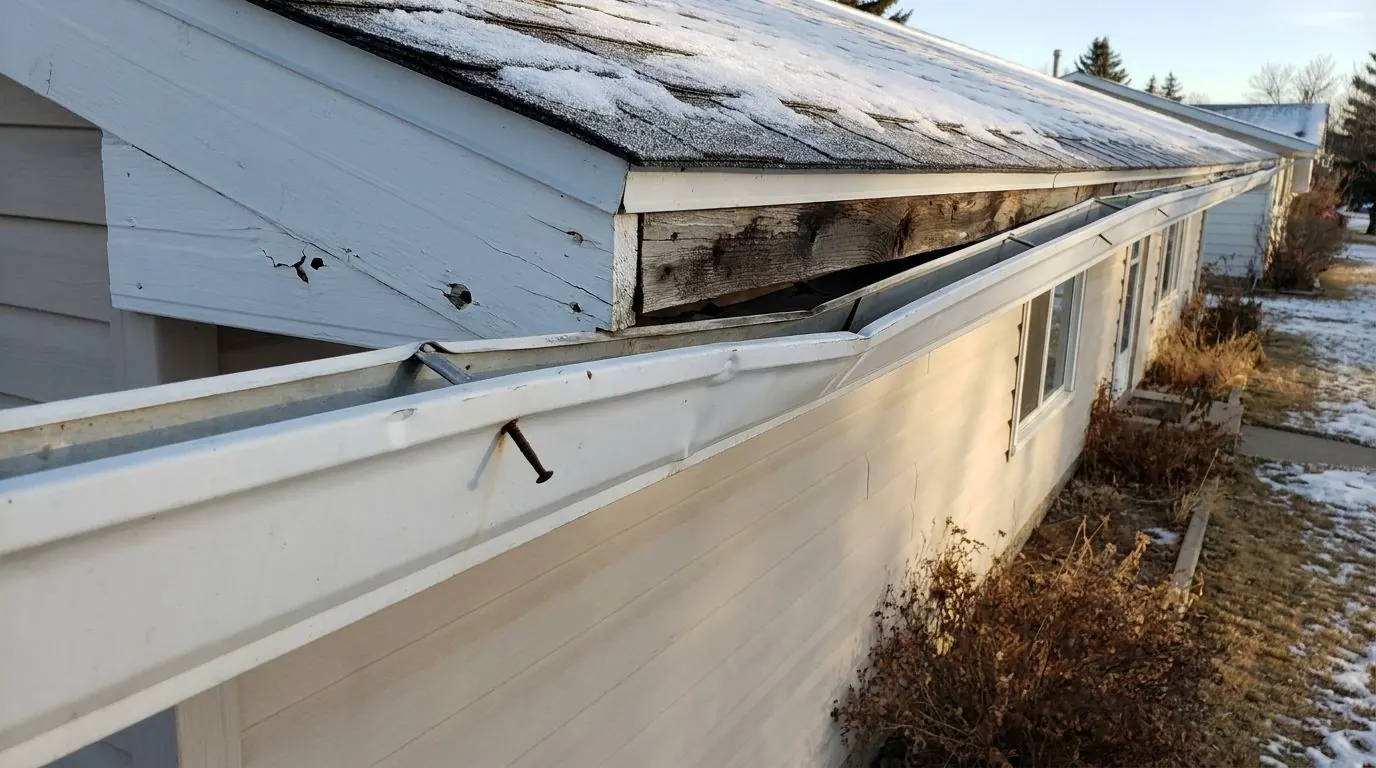
An eavestrough is supposed to run in a straight, gently falling line from its high end to the downspout. When one section drops, even by an inch, it stops being a channel and becomes a basin. Water collects in the dip instead of flowing to the outlet. In summer that means a trough that is always half full, a stripe of algae and grit along the low spot, and water spilling over the front lip in every heavy rain, straight down beside the foundation where it does the most harm.
In an Airdrie winter the dip becomes a trap. Meltwater from a Chinook afternoon runs into the low section, refreezes overnight, and adds a block of ice to a run that was already failing. That extra weight pulls harder on the fasteners that are left, so the sag deepens, which holds more water, which freezes into more ice. After a few rounds the trough can peel away from the fascia at one end, bend at a hanger, or open up a corner that was sealed perfectly well while the run was straight.
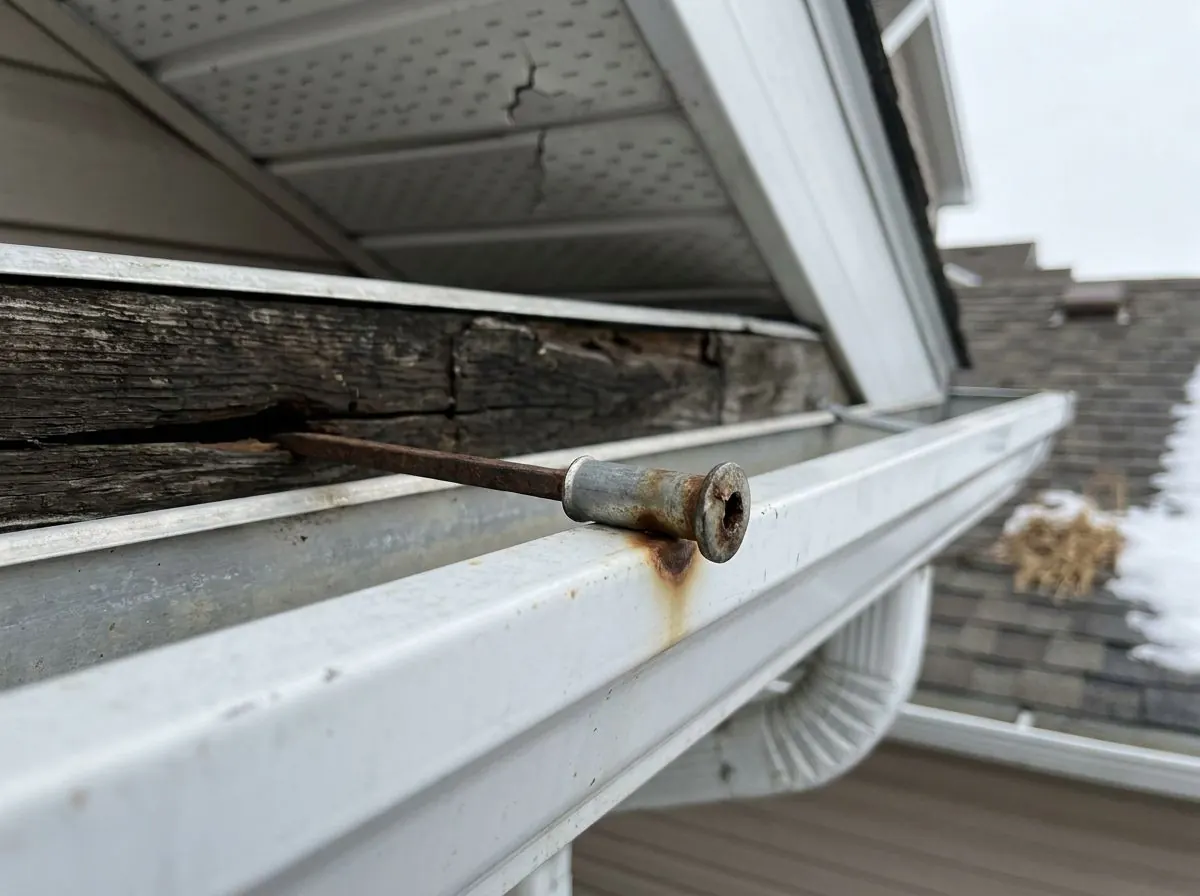
The cause is usually hiding behind the trough. On older houses the eavestroughs were often hung with long spikes driven through a ferrule into the fascia; as wood shrinks and freeze–thaw works the spike back and forth, it slowly backs out. Elsewhere hangers were spaced too far apart for snow country, were never driven into anything solid, or were screwed into a fascia board that has since gone soft from years of overflow. Simply bending the trough back up and adding a screw treats the symptom and leaves whatever caused it in place.
How It Works
We start by finding out why the run dropped. Every fastener along the sagging section is checked, and we look at whether the trough sags between widely spaced hangers, has pulled away at spikes that backed out, or is hanging from a fascia board that no longer holds a screw. We probe the fascia and, where we can reach them from the ladder, the rafter tails or truss ends behind it. The answer decides the repair: a fastening problem gets re-anchored, while a wood problem gets fixed before anything is re-hung.
Re-anchoring means the old spikes and ferrules, often rusted or loose by now, come out and hidden hangers go in. Each hanger clips inside the front lip of the trough and screws through the back of the trough into the fascia and, where the framing lines up, into the rafter tail behind it. We space them 12–18" apart, closer than the roughly 24" many manufacturers list as typical, and add one at every corner and outlet, because in snow and ice country those are the points that carry the load. Corrosion-resistant screws long enough to reach solid wood replace fasteners that were only gripping trim.
Re-pitching happens at the same time, because a sagging trough has almost always lost its fall. We loosen the run, set a string line or laser from a fixed high point, and re-hang the trough so it falls about 1/4" per 10 feet toward the outlet, or a little more where the run needs it. The low spot disappears, water drains instead of pooling, and the ice that was pulling the run down no longer has a basin to form in. We finish with a water test along the full length.
How the Job Runs, Step by Step
Measure the sag and find the cause
We sight and measure the run to see where it drops and by how much. Every spike, ferrule and hanger along the section is checked for looseness, spacing and what it is actually fastened into. This tells us whether we are dealing with fasteners, overload, damage or rot.
Probe the fascia and framing
The fascia board is tested along the run for soft or punky wood, and we check the rafter tails or truss ends we can reach. If the wood will not hold a screw, we stop and show you before re-hanging anything. Rot repair is carpentry and comes first.
Pull old fasteners and loosen the run
Backed-out spikes and ferrules are pulled, broken hangers removed, and the trough is released along the sagging section. Holes left by old spikes are sealed so they do not let water into the fascia behind the trough.
Set a line and re-pitch
A string line or laser is set from a fixed high point so the run falls steadily toward its downspout. We re-hang the trough to that line, removing the dip rather than just lifting the lowest point. The front lip is kept just below the roof plane so sliding snow clears it.
Install hidden hangers and water-test
Hidden hangers go in 12–18" apart and at every corner and outlet, screwed into solid wood. Corners disturbed by the sag are checked and re-sealed if they opened. We run water down the full length to confirm it drains to the outlet with nothing left standing.
What Decides the Specification
Three things decide how a sag gets fixed: what the trough is fastened into, how far apart the fasteners are, and whether the metal is still straight. Hidden hangers are only as strong as the wood behind them, so where the fascia is sound we drive into it, and where the rafter tails line up we reach them for extra bite. Spacing is set for snow load rather than the minimum. A .027" trough benefits from the closer end of the 12–18" range; heavier .032" coil is stiffer between hangers but still needs the same anchoring at corners and outlets.
The trough itself has to be worth re-hanging. Aluminum that sagged gently can usually be lifted back into line with no lasting harm. A run that was bent at a hanger, kinked by a ladder, split at a corner or dented along its length will hold a low spot no matter how carefully it is pitched. In those cases a new seamless run is the honest recommendation, and a full hanger layout or pitch redesign across the whole house is a separate job from fixing one tired section.
Code, Bylaw and Manufacturer Notes
Re-hanging and re-pitching existing eavestroughs is generally maintenance and not usually permit work. Replacing rotted rafter tails or other structural roof-edge framing is a different matter and may need a permit, so check with the City of Airdrie, or with Rocky View County, Cochrane or Calgary depending on your address, before that carpentry starts. Hanger manufacturers publish their own spacing and fastening instructions; our 12–18" spacing is tighter than the typical figure, which suits a climate with heavy ice loads.
Re-pitching changes where water leaves the roof, so it has to land in the right place. The City of Airdrie's drainage bylaw (B-03/2014) asks that roof water be directed away from the building, not onto walkways, landings or neighbouring property, and that downspouts sit at least two metres from a swale and not end less than two metres from the property line. If moving a run's fall means adding or shifting an outlet, we plan the downspout so it still follows those rules.
General guidance only. The municipality, its bylaws and the manufacturer’s installation instructions decide what applies to your job.
Around Airdrie
Hillcrest is one of the neighbourhoods holding Airdrie's older homes, and older housing is where the classic spike-and-ferrule sag is most common. Houses of that age often have eavestroughs hung with long spikes driven into the fascia, and after decades of Chinook freeze–thaw cycles those spikes work loose one by one. The run droops between the survivors, water sits in the dips, and the ice that forms each winter pulls it down further. Re-anchoring with hidden hangers into the rafter tails is often all these systems need, provided the fascia behind them is still sound.
Old Town, around the city centre, adds the other half of the story. On older houses that have lived through a lot of overflow, the fascia behind a sagging run is sometimes the real cause: water that spilled over the dip for years has softened the board until screws simply spin. That is a common finding on older homes in Old Town and in similar older stock in Crossfield and on acreages across Rocky View County. On those jobs we show you the soft wood, get the rot repaired, and only then re-hang and re-pitch the eavestrough.
Often Done Alongside
Heavy-Duty Hidden Hanger Fastening Systems
Hidden hangers 12–18" apart, screwed into solid wood to carry ice and snow.
Custom Pitch & Slope Optimization
Laser-set fall, split pitch on long runs, no standing water in the trough.
Corner Joint Re-Sealing & Leak Repair
Leaking corners, end caps and outlets stripped, re-sealed, riveted and water-tested.
Where We Do This Work
Sag Repair: Questions We Get
Why did my eavestrough start sagging in the middle of winter?
Can a sagging eavestrough be fixed without replacing it?
How do you know if the fascia behind the sag is rotted?
Will the eavestrough look crooked after it is re-pitched?
How do you work out what my eavestroughs actually need?
Considering Sag Repair?
Call Airdrie Gutters or send the details. We will look at the job, tell you whether sag repair is the right fix, and price it in writing.