Gutter Pitch & Slope Correction for Airdrie Eavestroughs
Water that sits in your eavestrough after the rain stops is a slope problem. We lay out the fall of every run with a laser level, split long runs to two downspouts and set the front lip correctly, so the trough empties before the next Airdrie freeze.
The Problem It Solves
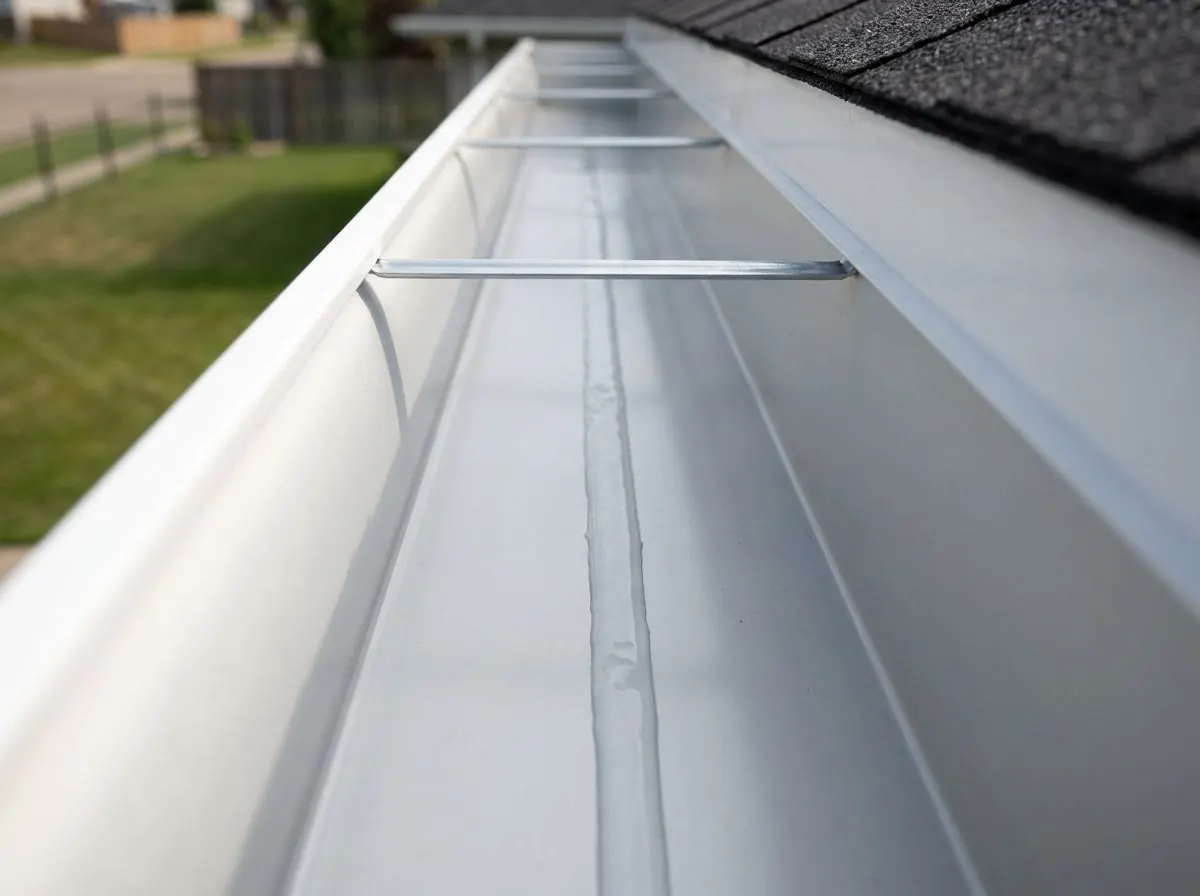
Many eavestroughs were hung by eye. The installer held the trough up to the fascia, followed the roofline, and fastened it where it looked straight. The trouble is that fascia boards and rooflines are rarely level, and houses settle. A trough that follows the fascia can end up flat, or even sloped away from the downspout for part of its length. After a rain you'll see it as a line of standing water along the bottom of the gutter, a ring of grit where puddles dried, or a drip line from a mid-run low spot rather than from the outlet.
Standing water in a gutter causes damage in every season. In summer it collects roof grit and shingle granules that settle into sludge, holds seeds that sprout, and keeps the mitres and end caps wet so their sealant breaks down faster. In winter it's worse. Airdrie's chinook cycles mean that puddle freezes, thaws and refreezes many times. Each freeze adds a layer of ice that doesn't drain, the trough grows heavier, and the fasteners take strain they weren't set for. Eventually the low spot sags further, which collects more water, and the cycle feeds itself.
The opposite mistake is just as common on long eaves. To make sure water reaches a single downspout at one end of a 50- or 60-foot run, the trough gets steep fall along its whole length. The far end then sits several inches lower than the high end, which looks visibly crooked against the roofline from the street, and often drops the front lip so low at the outlet end that roof water shoots past it. Owners end up choosing between a gutter that holds water and a gutter that looks wrong, when neither is necessary.
How It Works
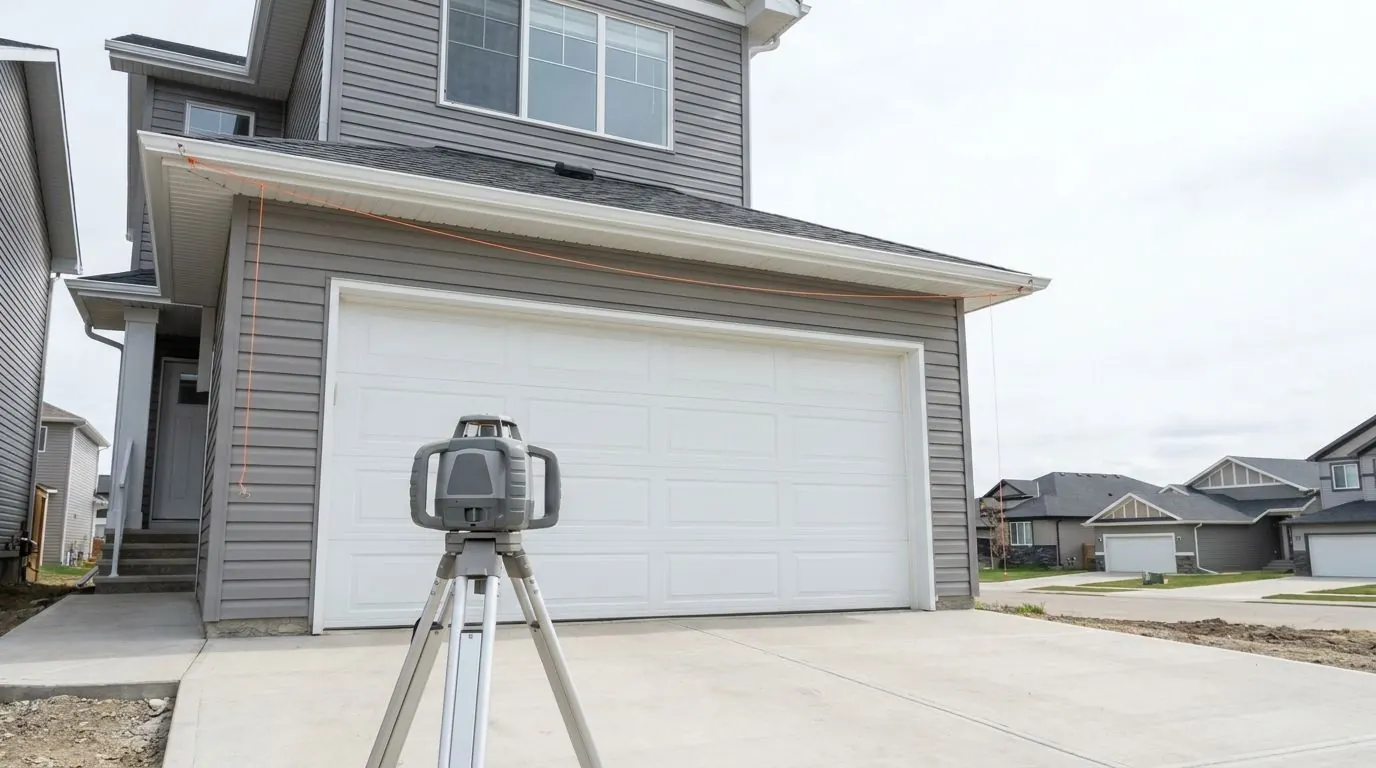
Correct slope starts from a fixed reference, not the fascia. We set a laser level or tight string line off a fixed high point on each run, then mark the fall toward the outlet along its full length. The common starting point is about a quarter inch of fall for every 10 feet of run, increased toward about a half inch per 10 feet on runs that need to move water faster, such as below a valley or where debris tends to settle. The trough is then hung to that line, regardless of what the fascia board is doing.
Long runs get split pitch. Rather than tilting one 60-foot trough all the way to a single corner, we set the high point near the middle of the run and slope each half down to its own downspout at each end. On runs over about 40 feet this halves the drop at each end, keeps the gutter looking parallel to the roofline, and gives the water two exits instead of one. Where a single outlet is unavoidable, we balance fall against appearance and tell you which way we've leaned.
The front lip completes the job. As common practice, the outer edge of the trough sits slightly below an imaginary line extending the roof plane, so sliding snow and ice pass over it instead of catching and tearing at the gutter, while normal rainfall still lands inside. What you get is an eavestrough that empties completely after rain, doesn't build ice in low spots between thaws, keeps its sealant dry, and still looks straight from the street.
How the Job Runs, Step by Step
Water-test the existing runs
We run a hose at the high end of each gutter run and watch where water flows, where it stalls and where it pools. We also read the evidence of past standing water: grit rings, stained seams and ice scars on the fascia. This shows exactly which runs, or which parts of a run, have the wrong fall.
Shoot the fixed reference line
A laser level or string line is set off a fixed high point on each run. From that reference we measure how far the existing trough departs from true, and how far the fascia itself is out of level. That tells us whether re-hanging will hold the right fall or whether the fascia needs shimming.
Plan the fall and split points
For each run we choose the fall, from about 1/4" to about 1/2" per 10 feet, and decide where the high point sits. Runs over about 40 feet are usually split at the middle to two downspouts. If that means a new outlet, we plan where its downspout will discharge away from the foundation.
Re-hang the trough to the marked line
We loosen or remove the existing fastening, lift the trough to the marked slope line, and set the front lip height relative to the roof plane. The trough is then fastened with hidden hangers into solid wood at close spacing, so the new slope is locked in rather than left to drift.
Re-test and seal disturbed joints
We run water through every corrected run again and confirm it drains fully to the outlets with nothing left sitting in the trough. Corners and end caps that flexed during re-hanging are checked and re-sealed on clean metal where needed, so a slope fix doesn't create a new leak.
What Decides the Specification
Run length and outlet position set most of the slope decision. A short run with a downspout at one end can take a quarter inch per 10 feet and still look level. A long run to a single outlet accumulates drop quickly, so it either gets split pitch or a second downspout. Runs that carry more debris, collect shingle granules below a steep roof, or sit on shaded sides where ice lingers benefit from the steeper end of the range, because moving water faster means less settles and less stays behind to freeze.
The house itself sets the limits. Fascia that's out of level may need the trough to depart visibly from it, and the gap is sometimes shimmed so the hangers bear evenly. The drip edge and roof edge decide how low the front lip can go before rain falls behind the trough. On houses with two-storey eaves the look from the street matters less than on a low bungalow front, where a visibly tilted gutter is obvious. We weigh all of these on each run rather than applying one number to the whole house.
Code, Bylaw and Manufacturer Notes
Re-hanging gutters to correct their slope is maintenance work that generally doesn't need a building permit in Alberta; check with the City of Airdrie or your municipality if the work extends to structural fascia or roof repairs. The fall figures used here are common trade practice rather than code requirements. What slope work can change is where water leaves the house: splitting a run adds a downspout, and the City of Airdrie's drainage bylaw (B-03/2014) expects downspouts not to discharge onto neighbouring property, stairs or walkways, to be at least two metres from a swale, and not to end within two metres of the property line. We plan any new outlet with that in mind.
General guidance only. The municipality, its bylaws and the manufacturer’s installation instructions decide what applies to your job.
Around Airdrie
Bayside and Canals were largely built through the 2000s and 2010s, and homes of that era commonly have long, uninterrupted eaves: wide two-storey fronts, attached garages that extend the eave line, and long rear elevations. Those long runs are exactly where single-outlet gutters pitched by eye go wrong. It is common to find eavestroughs on houses like these that hold a strip of water across the middle of the run, or that fall so steeply to one corner that the outlet end sits noticeably lower than the rest. Splitting those runs to two downspouts is often the cleanest fix.
Settlement is a factor too. Houses of that age in Canals and Bayside have had time to move slightly on Airdrie's clay-rich soils, and a trough that was level-looking when installed can develop flat or backward sections as the framing shifts. Drainage placement matters as well, because a new downspout for a split run has to discharge away from the foundation and away from walkways, and in some rear yards a swale sets how close the outlet can sit.
Often Done Alongside
Sagging Gutter Re-Pitching & Re-Anchoring
Drooping eavestroughs re-pitched and re-anchored into solid wood, with rot found first.
Foundation Water Pooling & Basement Leak Prevention
Trace roof water to the foundation and stop it before it reaches the basement.
Corner Joint Re-Sealing & Leak Repair
Leaking corners, end caps and outlets stripped, re-sealed, riveted and water-tested.
Where We Do This Work
Pitch & Slope: Questions We Get
How much slope should an eavestrough have?
Is a little standing water in the gutter normal?
Can you fix the slope without replacing my gutters?
Why does my gutter look crooked from the street?
How do you work out what my eavestroughs actually need?
Considering Pitch & Slope?
Call Airdrie Gutters or send the details. We will look at the job, tell you whether pitch & slope is the right fix, and price it in writing.