Flip-Up Downspout Extensions That Meet Airdrie's Two-Metre Drainage Rule
A downspout that empties at the foundation undoes everything the eavestrough is there for. We fit hinged, flip-up extensions that carry roof water about two metres out, land it on a splash pad, respect the City's swale and property-line rules and fold up out of the way when you mow.
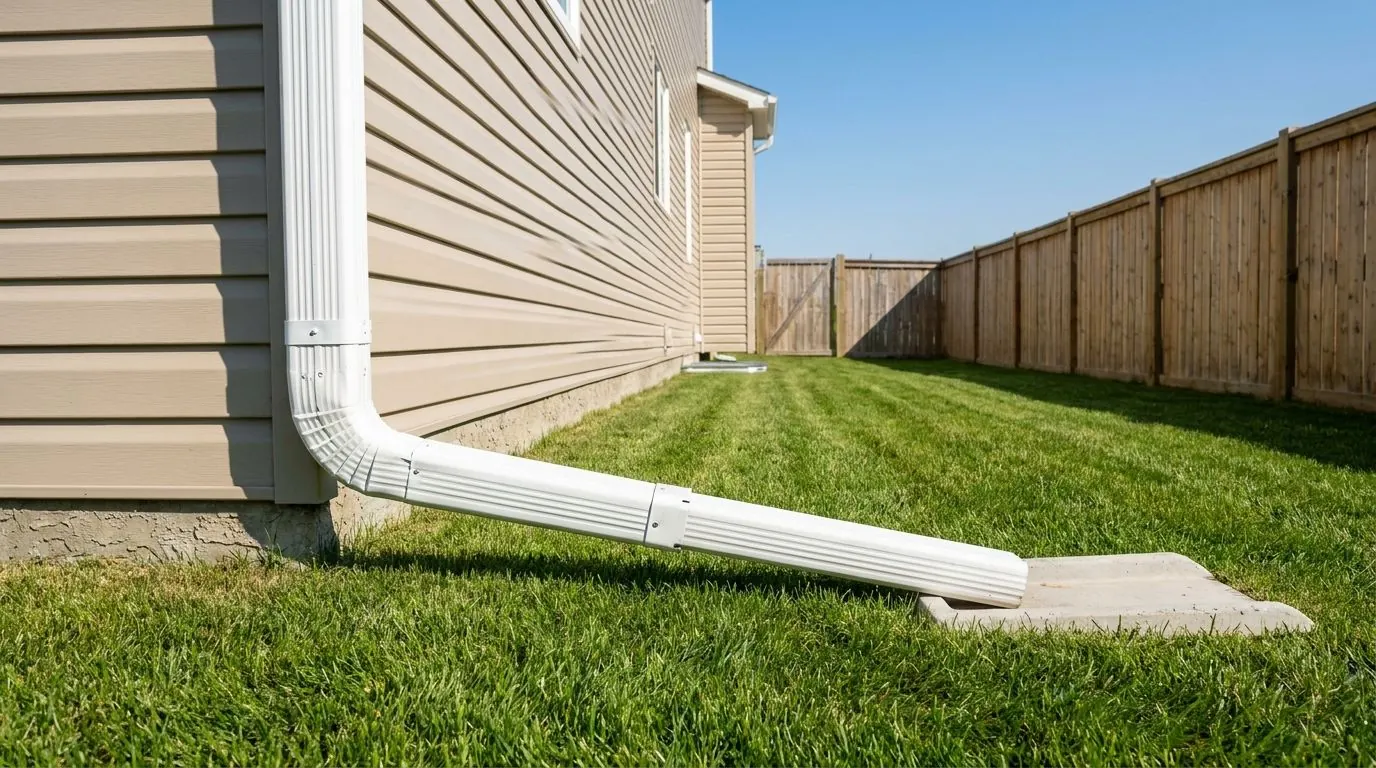
The Problem It Solves
It is common for Airdrie homes to be finished with a downspout that ends in a short elbow and a plastic splash block tipped against the foundation. That puts every drop of water from a whole roof plane within half a metre of the basement wall. In a summer thunderstorm a single downspout can pour a heavy, steady stream onto that spot, and the backfill beside a newer foundation is looser and more absorbent than the undisturbed ground further out. Water that lands there does not run away across the lawn; it finds the easiest route, which is straight down along the concrete toward the footing and the weeping tile.
On Airdrie's clay-rich soils, that becomes a slow, repeated soaking. Clay drains poorly, so water held against the foundation stays there, loads the weeping tile, runs the sump pump harder and eventually finds a crack, a tie hole or a window well. Along the way it settles the soil under walkways and patios so they tip back toward the house, which then sends even more water to the wall. By the time a damp corner shows up in the basement, the pattern has usually been going on for several seasons at the base of one or two downspouts.
The obvious fix, a long fixed extension, creates its own problems. A rigid pipe sticking two metres across the side yard gets stepped on, kicked, crushed by the lawn mower and pulled loose by kids and dogs, so it ends up shortened or removed and the water goes back to the wall. In a narrow side yard it can block the only path to the back of the house. And an extension aimed in the wrong direction can put water straight into a neighbour's yard or onto the shared swale, which the City of Airdrie's drainage bylaw does not allow.
How It Works
A flip-up extension solves the convenience problem that makes people take extensions off. The section attaches to the downspout's bottom elbow with a hinge, so it stays down to carry water across the yard and lifts up against the wall when you mow, trim or need to walk past. Because it is part of the downspout rather than a loose piece sitting on the grass, it doesn't wander, get lost or end up pointing the wrong way after a windstorm. It also means the discharge point is set once, deliberately, instead of wherever the last loose piece of pipe happened to land.
We size and aim each extension so water travels at least about two metres from the foundation, typically six to ten feet depending on the lot, and lands on a splash pad or small rock bed on ground that slopes away from the house. That spreads the flow, stops it digging a hole in the lawn and keeps it on your own property. The extension is matched to the downspout, 2x3 or 3x4, so it doesn't choke the flow at the last metre, and it is made from prefinished aluminum in the same colour as the rest of the drop.
The part that takes judgment is placement. The City of Airdrie asks that downspouts discharge at least two metres from a swale and not end within two metres of the property line, and never onto a neighbour's lot, a walkway, stairs or a landing. On many side yards those rules and the two-metre target can't all be met pointing straight out from the wall. In those cases we look at turning the extension toward the front or rear yard, moving the downspout to a different corner of the eavestrough, or hand off to a buried line where surface discharge just won't fit.
How the Job Runs, Step by Step
Map every downspout and where it drains
We walk the house and note each downspout, what roof area feeds it and where its water currently goes. We look at the ground around each one for sunken backfill, washed-out rock, staining on the foundation and walkways that tip toward the wall. That shows which discharge points are doing damage now.
Measure setbacks to swales and lot lines
For each discharge point we find the swale, the property line and any walkway or stairs nearby, and check the ground slope in the direction the water would run. This is where we confirm whether a straight-out extension can reach about two metres from the house and still stay two metres clear of the swale and property line.
Choose the direction or move the downspout
Where the side yard is too narrow, we plan an alternative: turning the discharge along the wall toward open lawn at the front or back, or relocating the drop to a corner of the eavestrough with more room. If no surface route works, we recommend a buried line rather than an extension that breaks the rules.
Install the hinged extension and splash pad
The flip-up section is fitted to the bottom elbow, sized to the downspout and fastened so the hinge swings cleanly without twisting the drop off the wall. A splash pad or rock bed is set at the discharge point, bedded level with or slightly below the lawn so it catches the flow and the mower passes over.
Water-test and show you the winter position
We run water down each downspout to see where it lands and which way it travels from there. Then we show you how the extension lifts and lowers, and where it should sit through winter so meltwater from Chinook thaws drains out rather than backing up into the downspout.
What Decides the Specification
The hinge and the fit to the downspout decide how long a flip-up extension lasts. It has to swing up and down season after season of mowing and frost without loosening the downspout's straps or tearing the bottom elbow, so we fasten the drop securely above the hinge and use an elbow and extension sized to the pipe rather than a universal adapter that leaves a lip for debris. A 3x4 downspout gets a 3x4 extension. Aluminum in a prefinished colour keeps the extension from cracking in cold weather the way thin plastic extensions often do after a winter or two.
Length and landing are decided by the lot. The target is about two metres from the foundation, but the right length is the one that puts the water on ground that keeps sloping away, clear of the swale and the property line, and off any hard surface where it would freeze into a sheet of ice. Where grade near the house is flat or slopes back toward the wall, an extension alone won't solve the problem, and the grading needs attention first. We would rather tell you that than fit a longer pipe that moves the puddle a metre further out.
Code, Bylaw and Manufacturer Notes
The City of Airdrie's drainage bylaw (B-03/2014) and Community Standards Bylaw set out the rules that shape every extension we install in the city. Downspouts must direct water away from the building and must not discharge onto adjacent property or onto external stairs, landings or walkways. The City asks that downspouts be at least two metres from a swale, and it is against the drainage bylaw to be closer, and that they not end less than two metres from your property line. Those setbacks are why a narrow side yard often calls for a different direction or a relocated downspout rather than a straight extension.
Downspouts are never to be connected to the sanitary sewer. Outside the city, Balzac, Cochrane, Crossfield, Irricana, north Calgary and Rocky View County each set their own drainage expectations, so check with that municipality before changing where water leaves a lot there.
General guidance only. The municipality, its bylaws and the manufacturer’s installation instructions decide what applies to your job.
Around Airdrie
Newer Airdrie subdivisions show this problem most clearly. In Prairie Springs, as in much of Airdrie's 2010s-onward growth, it is common for homes to sit close together with narrow side yards and a shallow swale running along the lot line between houses, so a downspout at the side of the house often has barely enough room to reach two metres from the foundation before it is too close to the swale or the neighbour's property. Builders commonly ran those downspouts into a splash block right at the wall. The yards also have young lawns and fresh backfill that settles for several years, which means discharge that looked acceptable at possession slowly starts running back to the foundation.
Coopers Crossing, largely 2000s–2010s housing, commonly shows a slightly older version of the same layout: tight side yards between two-storey homes, side-yard swales, and landscaping that has now matured enough for walkways and rock beds to have sunk against the walls. There the fix is often part extension and part rethink, turning one side-yard downspout toward the backyard lawn, moving another to the front corner of the eavestrough, and fitting flip-up extensions where the yard allows. Owners get water that leaves the foundation, stays off the neighbour's side and doesn't trip anyone on the way to the back gate.
Often Done Alongside
Foundation Water Pooling & Basement Leak Prevention
Trace roof water to the foundation and stop it before it reaches the basement.
Underground Drainage Tie-Ins & Rain Barrels
Sloped buried lines, emitters, winter overflows and rain barrel diverters.
Oversized 3x4 Inch Commercial Downspouts
3x4 downspouts with double the opening of a 2x3, for busy roofs and commercial runs.
Where We Do This Work
Flip-Up Extensions: Questions We Get
How far should a downspout extension carry water from my house in Airdrie?
Should flip-up extensions be up or down in winter?
Can I run my extension onto the lawn next door if theirs is lower?
Will a flip-up extension get damaged by the lawn mower?
How do you work out what my eavestroughs actually need?
Considering Flip-Up Extensions?
Call Airdrie Gutters or send the details. We will look at the job, tell you whether flip-up extensions is the right fix, and price it in writing.