Oversized 3x4 Downspouts for Airdrie Homes, Townhomes & Commercial Roofs
When an eavestrough overflows right beside the downspout, the trough usually isn't the problem: the drop is. We retrofit oversized 3x4 downspouts with larger outlets and smarter elbow layouts so roof water leaves the gutter as fast as the roof delivers it.
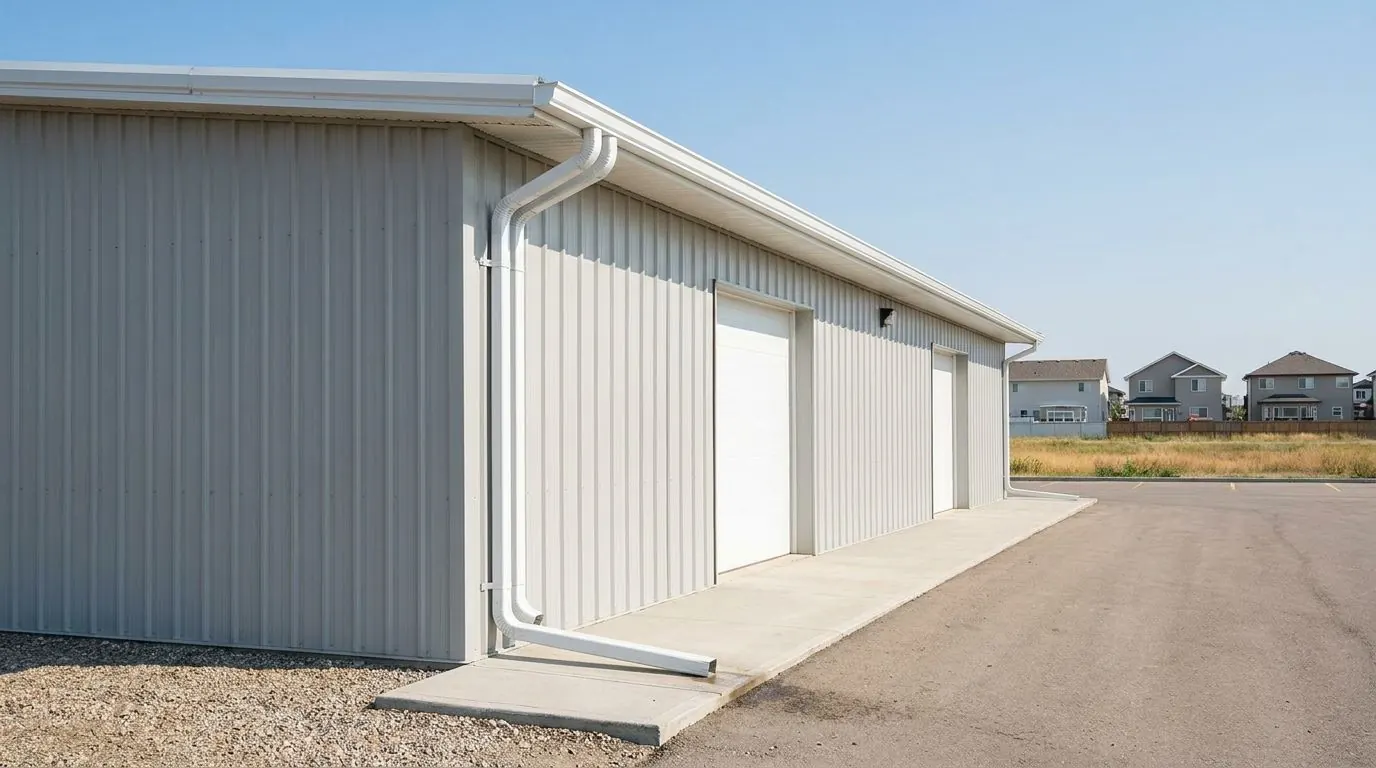
The Problem It Solves
A common overflow pattern on Airdrie homes happens within a metre or two of a downspout. Water sheets over the front lip of the eavestrough, straight onto the flower bed or the walkway below, while the rest of the gutter run looks fine. Homeowners assume the trough is too small or plugged, but when the trough is clean and still overflowing at the outlet, the downspout is the bottleneck. A standard 2x3 downspout has a small opening, and every elbow, offset and piece of debris in it cuts that opening further. In a hard summer downpour, the trough simply delivers water faster than a 2x3 drop can swallow it.
The consequences land at the worst possible spot. The downspout corner is usually where the roof concentrates water: the end of a long run, the bottom of a valley, or the place two roof planes meet. When the gutter overflows there, a heavy stream falls against the foundation wall in exactly the location the downspout was supposed to protect. On Airdrie's clay-rich soil that water doesn't drain away quickly; it soaks down along the backfill. Repeated every storm, it shows up as wet basement corners, heaved walkways, washed-out landscaping rock and a dark stain running down the fascia behind the overflow point.
Winter makes an undersized drop worse. Chinook thaws send meltwater off the roof in the middle of the day, and a small downspout carries a thin trickle that refreezes on the inside walls when the temperature drops again at night. A few cycles of that and the downspout closes from the inside, the outlet backs up, and the trough fills with ice at the corner. The result is a heavy block of ice hanging on the hangers nearest the outlet, water spilling over the lip on the next thaw, and icicles forming right over a doorway or stair. A larger opening does not stop freezing, but it takes a lot more ice to close it.
How It Works
A 3x4 downspout has roughly twice the cross-sectional area of a 2x3: about twelve square inches of opening instead of six. That extra room lets water fall freely down the pipe rather than stacking up in the outlet, and it lets leaves, seeds and shingle granules pass through instead of lodging at the first elbow. We pair the larger drop with a correctly sized outlet in the trough bottom, because a 3x4 downspout hung off a small outlet hole just moves the bottleneck up a few centimetres. The outlet is cut clean, crimped into the trough and sealed so the joint doesn't become the next leak.
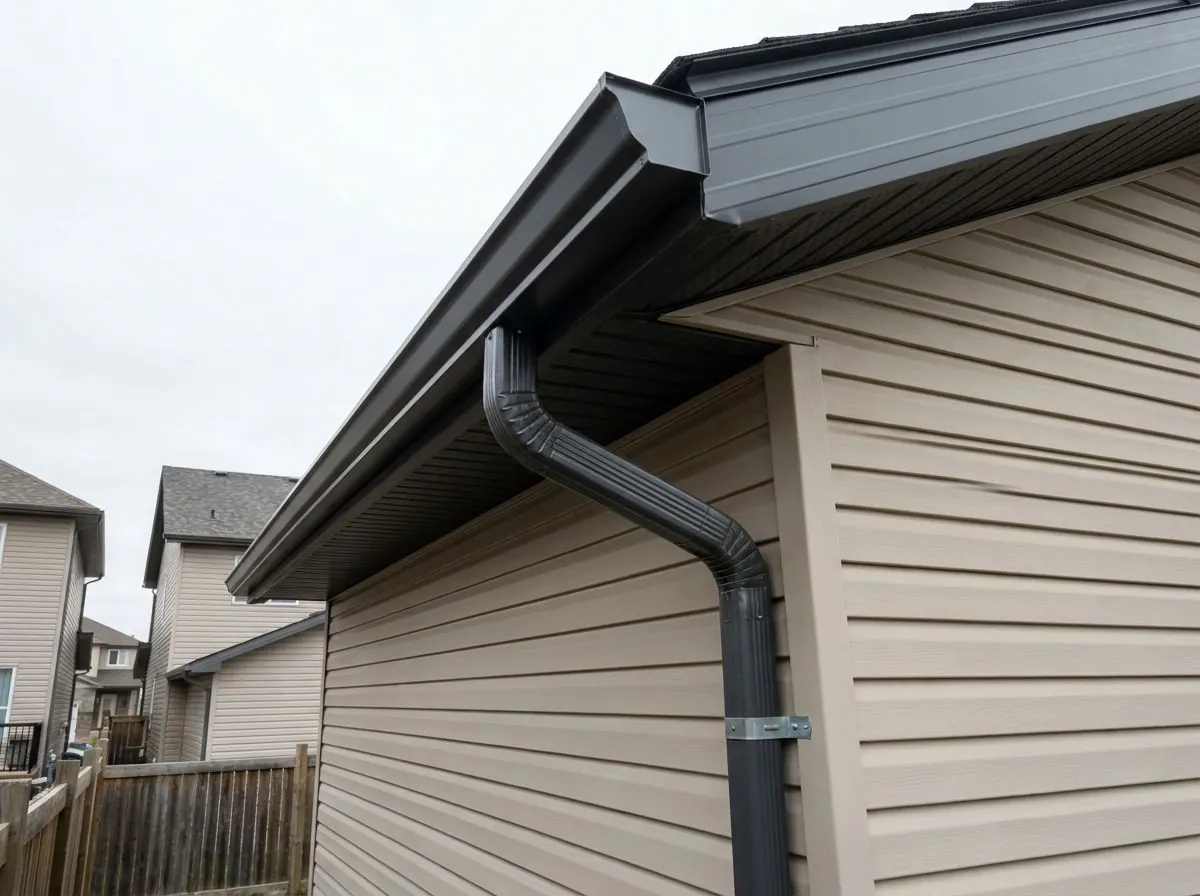
Layout matters as much as size. Every elbow slows water and gives debris a ledge to catch on, so we plan the route down the wall with the fewest bends that still clear bump-outs, window wells, gas meters and the path of foot traffic. Where an offset is unavoidable, a wider, gentler offset carries water better than two tight elbows stacked together. At the bottom, the discharge elbow is set so the 3x4 pipe can accept an extension or connect to a buried line without a reducer that would choke it back down to a 2x3 opening.
Sometimes the right answer is a second downspout rather than a bigger one. On a long run or a roof where two valleys empty toward the same corner, splitting the water between two drops shortens the distance water travels in the trough and halves what each outlet has to handle. We look at both options on site and choose the one that suits the roof, the wall and where the water can legally and safely go once it reaches the ground. If the eavestrough itself is undersized for the roof, we say so and point you to a larger trough rather than bolting a bigger drop onto a gutter that still can't keep up.
How the Job Runs, Step by Step
Find where the overflow starts
We look for the tell-tale signs of downspout-driven overflow: staining on the fascia beside the outlet, splash damage and erosion in the bed below, and debris or ice marks at the first elbow. If the weather allows, we run water into the trough at the outlet end to watch exactly where it backs up. That tells us whether the drop, the outlet or the trough is the limiting part.
Measure the roof feeding each drop
We work out which roof planes, valleys and upper roofs drain toward each downspout and note the pitch. A steep roof feeding one corner behaves very differently from a shallow plane spread across two outlets. This is what decides whether one 3x4 drop is enough or whether the water should be split between two downspouts.
Cut and seal the larger outlet
The old outlet is removed and a new 3x4 outlet is cut into the trough bottom at the low point of the run. It is crimped in, sealed and riveted so it is watertight and sits flush with the trough floor. If the trough has settled away from its pitch near the outlet, we correct the hangers there so water actually runs toward the new opening.
Route the drop with the fewest bends
We plan the path down the wall to clear windows, meters, bump-outs and walkways using as few elbows as possible, preferring wide offsets over tight stacked bends. Each section is fastened with straps into solid backing at the top, the bottom and along tall drops so wind, ice and ladder contact don't pull it loose.
Set the discharge and test the run
The bottom elbow is aimed away from the foundation and set up for a matching extension, splash pad or buried line connection without a reducer. We then flush water through the trough and down the new drop to confirm it drains fully and nothing leaks at the outlet, the elbows or the joints before we leave.
What Decides the Specification
The size of a downspout is decided by how much roof drains to it, how steep that roof is and how hard rain falls in a summer storm. Steep roofs deliver water to the trough faster, and valleys concentrate water from two planes into one short stretch of gutter, so the downspout at the bottom of a valley works much harder than one at the end of a gentle, open run. A 3x4 drop is standard with a 6-inch K-style eavestrough and can suit some 5-inch troughs where the outlet fits the trough bottom properly. On a 5-inch system with a tight trough, a second 2x3 downspout may be the cleaner fix, and we will tell you when that is the case.
Material and fastening decide how long the downspout stays straight and tight. We use prefinished aluminum colour-matched to the eavestrough and trim, strapped into solid backing rather than into siding alone. On tall two-storey drops and commercial walls, extra straps keep the pipe from bowing or separating at joints when ice forms inside it or when snow slides off the roof onto it. Joints are assembled so each upper section fits inside the section below it, the same way shingles overlap, so water running down the inside of the pipe can't escape through the seams.
Code, Bylaw and Manufacturer Notes
Replacing or resizing downspouts on an existing house generally does not need a building permit in Alberta, but commercial work can bring different requirements, so check with the municipality before a large project. More important for most homeowners is where the water ends up. The City of Airdrie's drainage bylaw (B-03/2014) and its community standards rules say downspouts must direct water away from the building, must not discharge onto adjacent property, onto external stairs, landings or walkways, and should end at least two metres from a swale and not less than two metres from the property line. A bigger downspout moves more water to one spot, which makes getting the discharge point right more important, not less.
Downspouts must never be connected to the sanitary sewer. In Balzac, Crossfield, Irricana, Cochrane, north Calgary and the rest of Rocky View County, the local authority sets its own drainage and discharge rules, so check with that municipality, particularly for commercial buildings with engineered site drainage.
General guidance only. The municipality, its bylaws and the manufacturer’s installation instructions decide what applies to your job.
Around Airdrie
In Airdrie, this pattern is common on newer attached housing. Townhomes and semi-detached homes in 2010s-onward areas such as Midtown and Ravenswood commonly have long shared roof lines, short gable returns and valleys that funnel several roof planes toward a handful of downspout locations. Builders tend to space those downspouts where they fit between garage doors and entries rather than where the roof delivers the most water, and they are commonly finished with standard 2x3 drops. The result can be a corner that overflows in a July thunderstorm while the rest of the eavestrough stays dry, often right above a front step or a shared walkway.
Just south of the city, commercial and light-industrial buildings around Balzac face the same issue at a larger scale: broad low-slope or steel roofs, long gutter runs and downspouts that have to carry a great deal of water down tall walls past loading areas and parking. Those buildings benefit from 3x4 drops or larger, fewer elbows, careful strapping and discharge that stays clear of pedestrian routes where winter ice would become a slip hazard. Across both kinds of building, the fix is the same principle: give the water an opening large enough for the roof that feeds it.
Often Done Alongside
6-Inch High-Capacity Commercial & Residential Gutters
6" seamless gutters and 3x4 downspouts for big, steep or complex roofs.
Flip-Up Downspout Extensions
Hinged extensions that carry roof water about 2 m out and lift for mowing.
Gutter Cleaning & Downspout Flushing
Hand-scooped troughs, flushed downspouts, augered elbows and a written report.
Where We Do This Work
3x4 Downspouts: Questions We Get
Can a 3x4 downspout be added to my existing 5-inch eavestrough?
Will a bigger downspout make my eavestroughs overflow less in winter?
Why does my gutter overflow right at the downspout corner even after cleaning?
Do larger downspouts look out of place on a house?
How do I know the work was done properly?
Considering 3x4 Downspouts?
Call Airdrie Gutters or send the details. We will look at the job, tell you whether 3x4 downspouts is the right fix, and price it in writing.