Buried Downspout Lines, Pop-Up Emitters & Rain Barrel Diverters in Airdrie
When there is no room on the surface for an extension, roof water can travel underground instead. We bury smooth-wall downspout lines sloped to drain empty, finish them at a pop-up emitter or daylight on your own lot, add a winter overflow for freeze-up, and fit rain barrels with diverters that send overflow back down the spout.
The Problem It Solves
Some lots simply don't have room for water on the surface. A downspout beside a patio, a front step, a driveway or a narrow side yard can't send its water across that hard surface or into the neighbour's yard, and a flip-up extension would either block a path or break the City of Airdrie's setback rules. Homeowners often solve it with a length of black perforated corrugated pipe pushed into a shallow trench, or a splash block that simply puts the water back at the foundation. Both approaches look tidy for a season and then quietly stop working.
Perforated corrugated pipe is made to collect water from the soil, not carry it away, so it leaks roof water into the ground along its whole length, often right beside the foundation where the trench started. Its ribbed walls trap shingle granules, seeds and silt, and the pipe sags in soft backfill so low spots hold water. In an Airdrie winter that standing water freezes solid, the downspout backs up, and on the next Chinook thaw the meltwater overflows at the elbow, where it runs down the wall or freezes into a sheet of ice over the step. Old buried lines that get dug up are often full of packed sediment and roots, or crushed flat under a lawn edge.
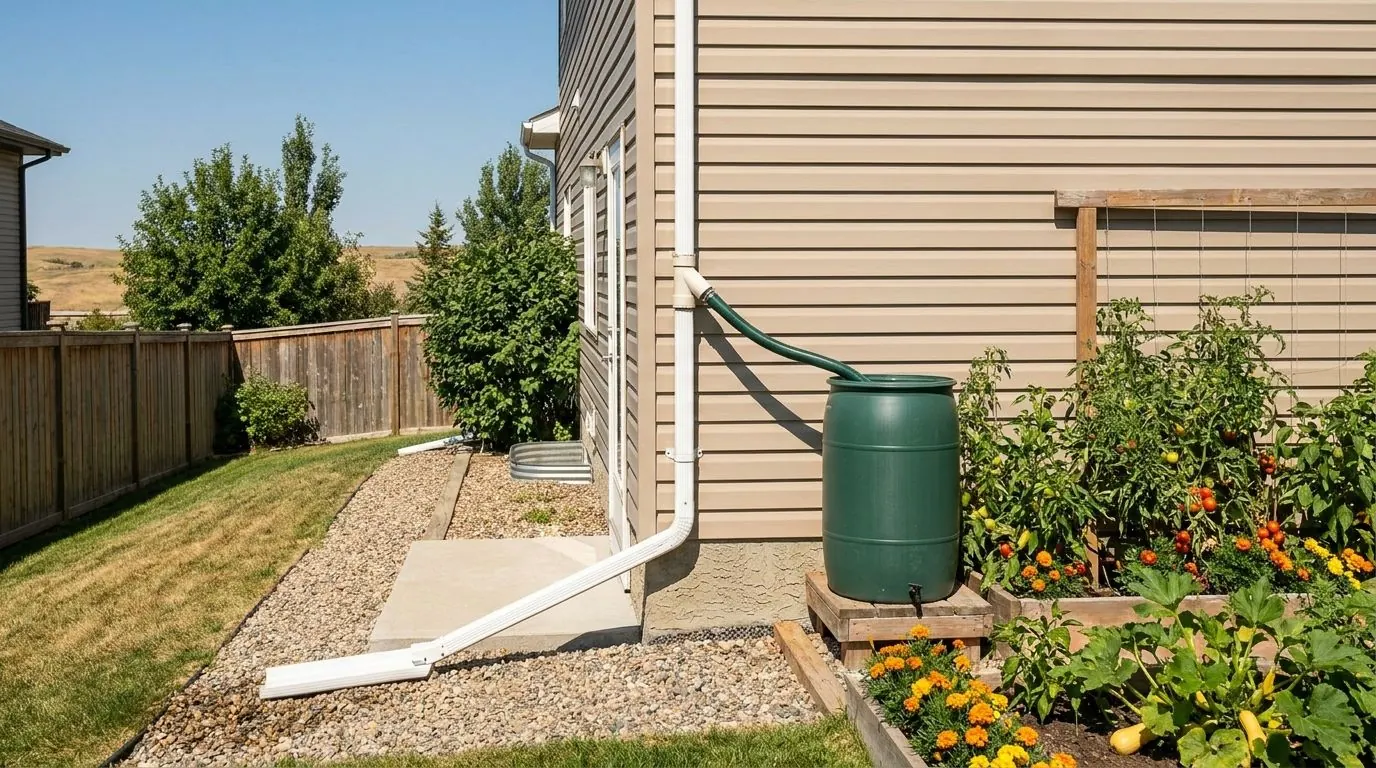
Rain barrels bring their own set of problems when they are set up without a plan. A barrel fed straight from a cut-off downspout fills in one storm and then overflows at its base, dumping water right against the foundation it was meant to protect. Left connected into October, a full barrel freezes, splits, and turns the downspout above into a column of ice that backs water up into the eavestrough. The idea is sound, collecting rainwater for the garden, but the connection has to handle a full barrel and the start of freeze-up.
How It Works
A properly built buried line is solid, smooth-wall PVC, commonly SDR-35 or a similar sewer-and-drain grade, laid on firm, compacted bedding with a continuous slope from the downspout to the outlet. Smooth walls let water carry grit through instead of dropping it in ribs, and continuous fall means the line drains empty after every rain, which is what keeps it from freezing solid. Because burying the pipe below frost on a residential lot is rarely practical, the design goal is a line that holds no water, not a line that never gets cold. A clean-out or removable connection at the downspout tie-in gives access for flushing, and the same tie-in is where a rain collection diverter can be added later.
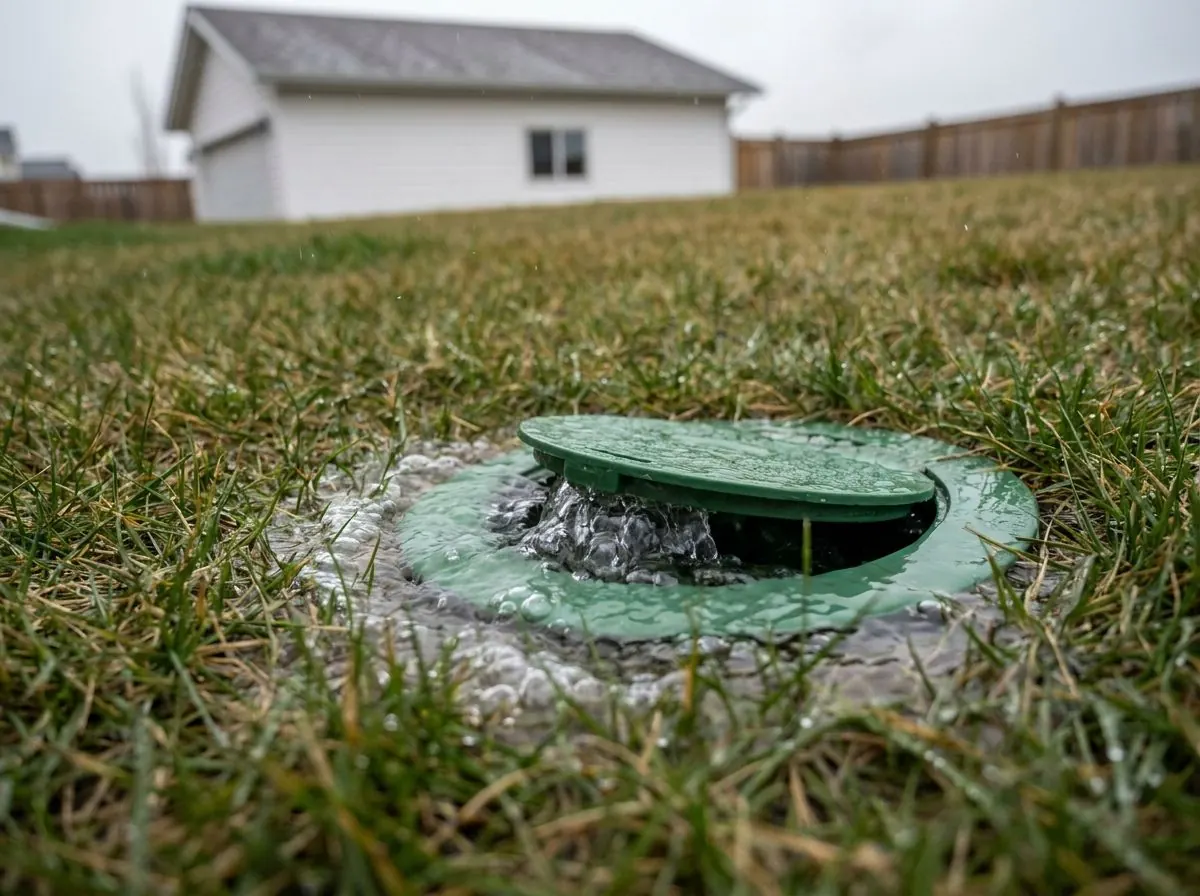
The outlet has to finish on your own property, away from the foundation, the neighbours and the swale. On a lot that slopes, the line can daylight to grade where the ground falls away, finishing in a small rock bed. On flatter Airdrie lots we use a pop-up emitter: a cap at the end of the pipe that lifts when water pushes up and drops closed again, sitting flush with the lawn. We add a winter overflow near the downspout, a disconnect or diverter that sends water to the surface when the emitter is frozen shut, so a buried line can't back ice up into your eavestrough.
For rain barrels, we fit a diverter into the downspout rather than cutting the downspout off above the barrel. The diverter fills the barrel through a short hose, and once the barrel is full, water carries on down the downspout to its normal extension or buried line instead of spilling over the barrel's rim. The barrel sits level on a solid base high enough to get a watering can under the tap. Before freeze-up, usually by October, the barrel is drained and disconnected, and the diverter set so the downspout runs straight through all winter.
How the Job Runs, Step by Step
Plan the route and the outlet point
We walk from each downspout to find where water can legally and usefully end up: on your lot, at least two metres from the swale and property line, and on ground that falls away. We check for gas lines, electrical and irrigation before digging, and locate underground utilities through the proper request so the trench stays clear of them.
Trench to a continuous fall
The trench is dug and the bottom shaped with a steady slope from the downspout end to the outlet, checked with a level along its length so there are no dips that would hold water. Soft spots are firmed and bedded so the pipe can't settle into a belly after the backfill goes in.
Lay smooth-wall pipe and the clean-out
Solid PVC is joined with proper fittings, using long sweeps instead of tight bends wherever the route turns so debris keeps moving. A clean-out or removable connection is fitted at the downspout end, with a debris-catching adapter where the downspout meets the line.
Finish the emitter or daylight outlet
At the far end we set a pop-up emitter level with the lawn, or daylight the pipe into a small rock bed where grade falls away. Then we backfill in layers, compact the soil so the trench doesn't sink, and restore the sod or rock over it.
Fit the winter overflow and flow-test
A disconnect or diverter is installed near the downspout so water has a surface route when the line is frozen. We run water through the whole system to confirm the emitter lifts, the line drains empty and nothing backs up at the downspout, then show you how to switch it for winter.
What Decides the Specification
Pipe choice decides whether a buried line lasts. Smooth-wall solid PVC carries water from one end to the other without leaking it into the backfill, resists crushing under a lawn edge better than thin corrugated tubing and lets a flush clear the whole length. Its diameter is set so the pipe can take everything the downspout delivers, including a 3x4 drop, without needing a reducer at the connection. Fittings are sweeps rather than sharp elbows, and the connection at the downspout includes a way to catch or clear debris, because shingle granules and seeds are what commonly fill buried lines in Airdrie.
Slope, outlet and winter planning decide whether it works in February. The line needs continuous fall along every metre so it drains completely; a single sag becomes an ice plug. The outlet needs to be on ground that carries water further away rather than back toward the house or across to a neighbour. A pop-up emitter will freeze shut in a cold snap, which is expected, so the system is only complete when a winter overflow near the downspout gives meltwater an above-ground route. For rain barrels, the diverter matters more than the barrel: one that returns overflow to the downspout keeps a full barrel from flooding the foundation.
Code, Bylaw and Manufacturer Notes
Roof water must never be connected to the sanitary sewer; municipal utility bylaws across Alberta prohibit it, so check with the municipality before tying into any existing underground pipe whose destination you don't know. Inside the city, the City of Airdrie's drainage bylaw (B-03/2014) and its community standards rules still apply to a buried line's outlet: water must be directed away from the building, must not discharge onto adjacent property, stairs, landings or walkways, and the discharge point should be at least two metres from a swale and not less than two metres from the property line. A pop-up emitter counts as a discharge point.
Always request a utility locate before digging. In Balzac, Cochrane, Crossfield, Irricana, north Calgary and elsewhere in Rocky View County, the local authority sets its own rules for connecting to storm systems, ditches or drainage easements, so check with that authority before a line crosses toward any of them.
General guidance only. The municipality, its bylaws and the manufacturer’s installation instructions decide what applies to your job.
Around Airdrie
Bayside is a good example of where buried lines earn their place. Largely built through the 2000s and 2010s, lots of that era commonly have front walks, driveways and rear decks tight to the house, with side yards too narrow for a two-metre extension that also stays clear of the swale. It is common to find downspouts turned into short lengths of perforated black pipe that ended within a metre of the foundation, now crushed or packed with grit. Replacing those with a smooth-wall line to a pop-up emitter in the front or back lawn, with a winter overflow at the wall, moves the water out while keeping the yard walkable and the steps clear of ice.
Woodside, built around the golf course, has more mature trees and established landscaping than the newer parts of Airdrie. That means leaves, seeds and needles going down the downspouts, and tree roots that find any leaking joint in an old buried line. Established gardens also make rain barrels a natural fit. In that setting, the work is usually replacing tired buried pipe with sealed smooth-wall runs and clean-outs, and converting cut-off downspouts over barrels to diverter fittings so a full barrel stops soaking the foundation every summer storm.
Often Done Alongside
Flip-Up Downspout Extensions
Hinged extensions that carry roof water about 2 m out and lift for mowing.
Foundation Water Pooling & Basement Leak Prevention
Trace roof water to the foundation and stop it before it reaches the basement.
Gutter Cleaning & Downspout Flushing
Hand-scooped troughs, flushed downspouts, augered elbows and a written report.
Where We Do This Work
Buried Lines & Rain Barrels: Questions We Get
Why do pop-up emitters stop working in winter, and is that a problem?
Can my downspouts be connected to my weeping tile or sump?
How do I stop a rain barrel from overflowing at the foundation?
How deep does a buried downspout line need to be in Airdrie?
Can eavestroughs be installed in an Airdrie winter?
Considering Buried Lines & Rain Barrels?
Call Airdrie Gutters or send the details. We will look at the job, tell you whether buried lines & rain barrels is the right fix, and price it in writing.