Upper-Roof Downspout Drops That Stop Shingle Wear on Airdrie Lower Roofs
On a two-storey home, the upper downspout often empties straight onto the garage or porch roof below. That stream strips shingle granules in a stripe, overshoots the lower gutter and freezes in winter. We redirect it with splash shoes, extension pipes and reroutes that deliver the water into the lower eavestrough.
The Problem It Solves
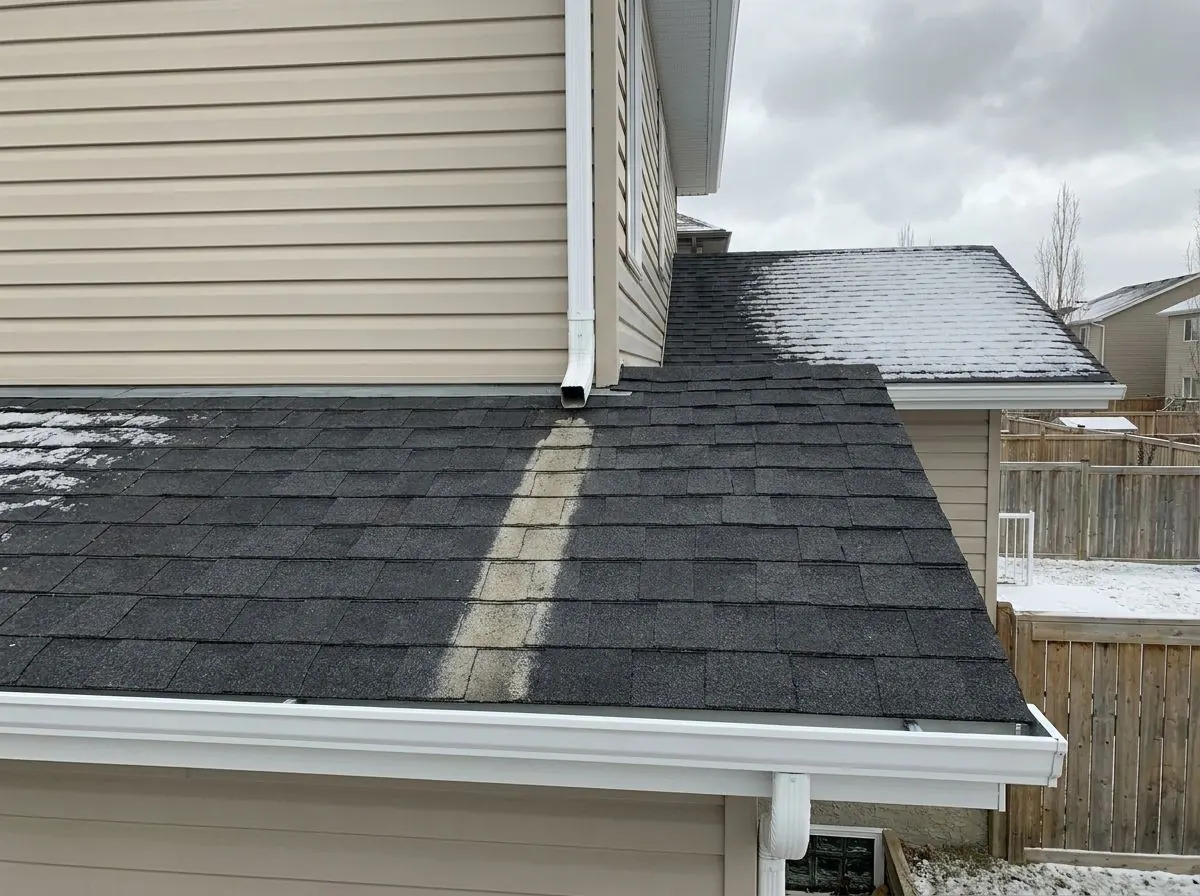
Look up at the roof over the garage on many two-storey Airdrie homes and you will see it: a darker stripe running down the shingles from the spot where an upper downspout ends a few centimetres above the lower roof. That stripe is where the stream of water from the whole upper roof hits the same few shingles in every rain and every thaw. The force of that concentrated flow washes the ceramic granules off the shingle surface, exposing the asphalt underneath to sunlight. Once the granules are gone, the shingles in that stripe dry out, curl and crack well ahead of the rest of the roof. That shingle erosion is premature roof wear in one concentrated line, and it can shorten the life of a lower roof that is otherwise sound.
The water doesn't stop doing damage once it has hit the shingles. A strong stream running straight down a short lower roof picks up speed and shoots over the front lip of the lower eavestrough, so the water that was collected so carefully up top lands on the driveway, the front step or against the garage wall anyway. Where the upper drop lands near a valley or a wall, the flow can push water sideways under the edges of shingles or into the step flashing where the lower roof meets the siding. Loose granules then wash into the lower gutter and build up as grit in its downspout.
Winter is where this detail causes the most trouble. On a sunny Chinook afternoon, snow on the upper roof melts and pours down the upper downspout onto a lower roof that may still be shaded and frozen. The water spreads over cold shingles and refreezes, building a sheet of ice that grows every thaw. That ice sits at the lower eave, blocks the lower eavestrough and can back meltwater up under the shingles, with heavy icicles hanging over the garage door. The bonus room or living space above the garage often adds heat loss to the mix, which makes the lower roof even more prone to melting and refreezing.
How It Works
The simplest fix is a splash shoe: a formed diverter fastened at the bottom of the upper downspout that catches the falling water, slows it and turns it down the slope of the lower roof instead of letting it hammer one spot. A splash shoe spreads the flow over a wider area, which reduces granule loss, and it points the water in the direction of the lower eavestrough. It suits short lower roofs, gentle flows and homes where the upper drop lands a short distance above the lower eave. It is not enough on its own where the lower roof is long, the upper roof area is large, or ice keeps forming in that path.
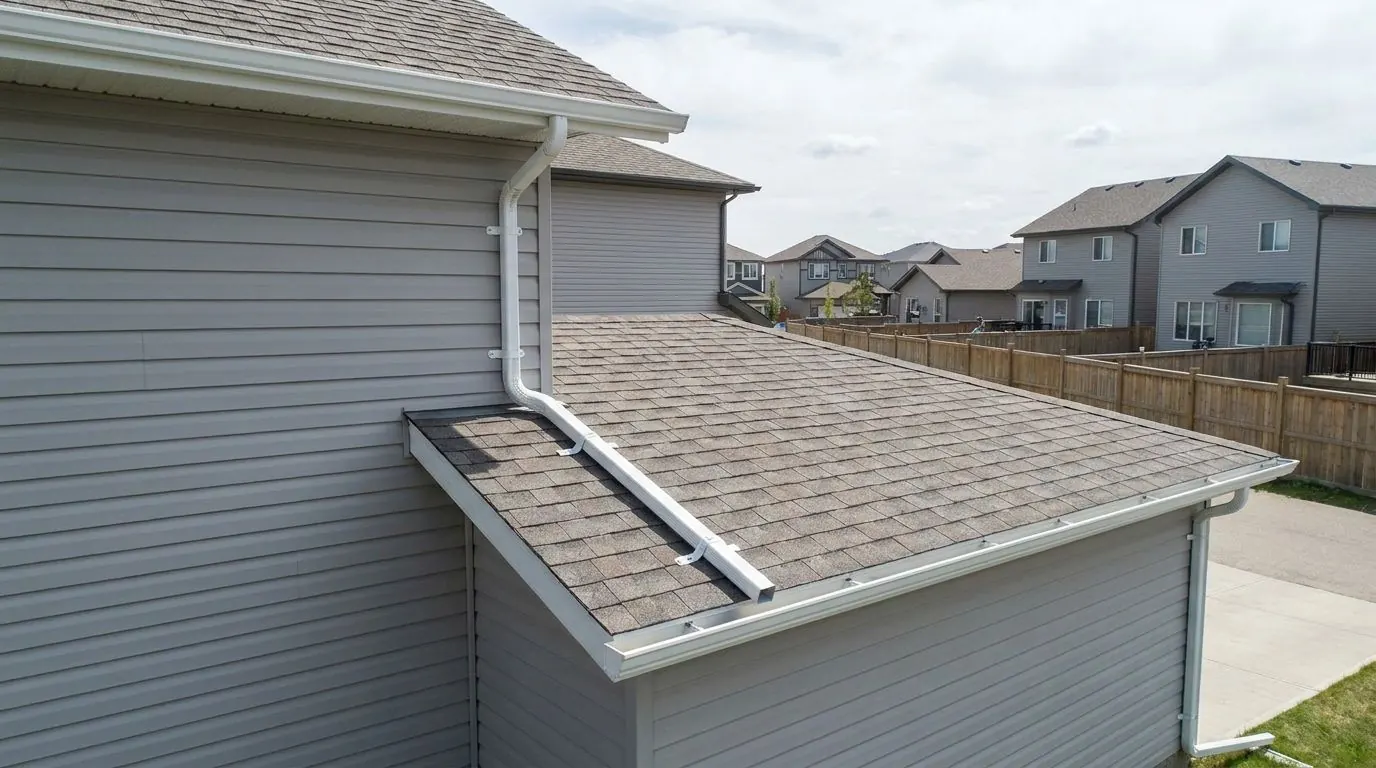
For those cases, we extend the downspout itself. An extension pipe continues from the upper drop down the lower roof and ends inside or just above the lower eavestrough, so the water never touches the shingles at all. Where the geometry suits it better, we carry the pipe across the lower roof to the end of the lower gutter, next to its downspout, so the combined flow goes straight down to the ground. The pipe is secured with straps and brackets placed to avoid driving fasteners through the shingle field wherever the layout allows, and it is kept clear of valleys and step flashing.
Sometimes the right answer is to take the upper roof water off the lower roof entirely. If there is a clear wall beside the garage or porch, the upper downspout can run down that wall to grade and finish at its own extension, bypassing the lower roof and the lower gutter completely. Whichever option we choose, we check the lower eavestrough before finishing, because it has to handle its own roof plus whatever the upper roof now sends into it. If the lower gutter is undersized or its outlet is too small for the combined flow, we tell you and correct it rather than moving the overflow down a level.
How the Job Runs, Step by Step
Trace the upper roof water path
From the ground and the roof, we identify which upper roof area drains to the drop, where it lands on the lower roof and where that water goes next. We look for the granule stripe, curled shingles, ice staining, overflow marks on the lower gutter and grit built up in its downspout. That tells us how much damage is already there.
Check the lower roof and lower eavestrough
We measure the distance from the upper outlet to the lower eave, note valleys, walls and step flashing in the path, and check the lower eavestrough's size, pitch and outlet. The lower gutter has to be able to take the combined flow before we send more water into it. If shingles in the stripe are already badly worn, we flag them for a roofer.
Choose shoe, extension, cross-roof or reroute
Based on the roof geometry and the flow, we recommend a splash shoe, an extension pipe to the lower gutter, piping across the lower roof to the gutter end or a full reroute down a wall. We explain why that option fits the house, including how it will behave with snow, sliding ice and Chinook melt.
Install and secure without damaging shingles
The upper downspout is shortened or refitted as needed and the shoe or pipe installed in prefinished aluminum matched to the eavestrough. Brackets and straps are placed to keep the pipe stable in wind and under snow while avoiding fasteners through the shingle field where the layout allows. The pipe outlet is set so water drops into the lower trough rather than over it.
Run water from the top and watch it land
We run water into the upper eavestrough and follow it all the way through: down the upper drop, across or down the lower roof, into the lower eavestrough and out its downspout. We confirm nothing splashes over the lower lip, leaks at joints or pools on the shingles before we pack up.
What Decides the Specification
The choice between a splash shoe and an extension pipe comes down to three things: how much upper roof drains to that downspout, how far the water has to travel down the lower roof and what happens to that lower roof in winter. A small upper roof dropping onto a short, sunny lower slope may only need a splash shoe to spread and turn the flow. A large upper roof, a long lower slope or a north-facing lower roof that stays shaded and frozen calls for piping the water all the way to the lower eavestrough so it never spreads across cold shingles. On a steep upper roof the flow arrives faster, which pushes the decision toward an extension.
The lower eavestrough is the other half of the specification. Once upper roof water is delivered into it, that gutter and its downspout carry two roofs' worth of water. We check that the lower trough is sized and pitched for it and that its outlet and downspout aren't a bottleneck, since a flow that the lower gutter can't swallow simply overflows at the point where the extension pipe ends. Where the lower system is undersized, upgrading that eavestrough or its downspout is part of doing the job properly, and a note about it belongs in our recommendation.
Code, Bylaw and Manufacturer Notes
Redirecting an upper downspout on an existing house generally does not need a building permit in Alberta, but check with the municipality if the work is part of a re-roof or larger renovation. Shingle manufacturers publish installation instructions and warranty conditions, and some shingle warranties may care about fasteners driven through the shingle surface, so it is worth checking your shingle documentation. We keep fasteners out of the shingle field wherever the layout allows for that reason.
Wherever the redirected water finally reaches the ground, the City of Airdrie's drainage bylaw (B-03/2014) still applies: it must be directed away from the building, not onto a neighbour's property, stairs, landings or walkways, and discharged at least two metres from a swale and not less than two metres from the property line. In Cochrane, Crossfield, north Calgary and Rocky View County, check with the local authority.
General guidance only. The municipality, its bylaws and the manufacturer’s installation instructions decide what applies to your job.
Around Airdrie
Kings Heights, largely 2010s-onward growth, is typical of the housing style that creates this problem: two-storey homes that commonly have a bonus room built over an attached front garage, set beneath a larger upper roof. To keep the front elevation clean, upper downspouts on houses like these are often dropped onto the garage roof rather than run down a wall, so a big share of the upper roof water lands on a short lower slope right above the garage door and driveway. After enough summer storms and winter thaws, the granule stripe and the ice at the lower eave above the garage door are easy to spot from the street.
Newer two-storey homes in Ravenswood commonly share the same layout, often with more complex upper roofs that feed several planes toward a single drop. On those homes the garage roof is also frequently shaded by the upper storey for part of the day, which is exactly the condition that turns Chinook meltwater into lower-roof ice. The fix there usually means a full extension pipe into the lower eavestrough, a check that the lower gutter and downspout can carry the extra water, and sometimes rerouting an upper drop down the side wall so the front garage roof carries only its own snow and rain.
Often Done Alongside
6-Inch High-Capacity Commercial & Residential Gutters
6" seamless gutters and 3x4 downspouts for big, steep or complex roofs.
Aluminum Drip Edge Flashing
Eave and rake drip edge, including retrofits under existing shingles.
Oversized 3x4 Inch Commercial Downspouts
3x4 downspouts with double the opening of a 2x3, for busy roofs and commercial runs.
Where We Do This Work
Upper-Roof Drops: Questions We Get
What is a splash shoe on a lower roof, and is it enough?
Why does ice build up on my garage roof below the upper downspout?
Can the upper downspout skip the lower roof completely?
Will an extension pipe across my lower roof damage the shingles?
Do I need a permit to replace eavestroughs, soffit or fascia?
Considering Upper-Roof Drops?
Call Airdrie Gutters or send the details. We will look at the job, tell you whether upper-roof drops is the right fix, and price it in writing.