Commercial & Multi-Family Gutter Service in Airdrie and Rocky View
Condo boards, property managers and business owners need eavestroughs that carry big roofs, stay clear of tenants and traffic, and get looked after on a schedule. We install, repair and maintain gutters on townhouse complexes, commercial bays and agricultural buildings across Airdrie and Rocky View County.
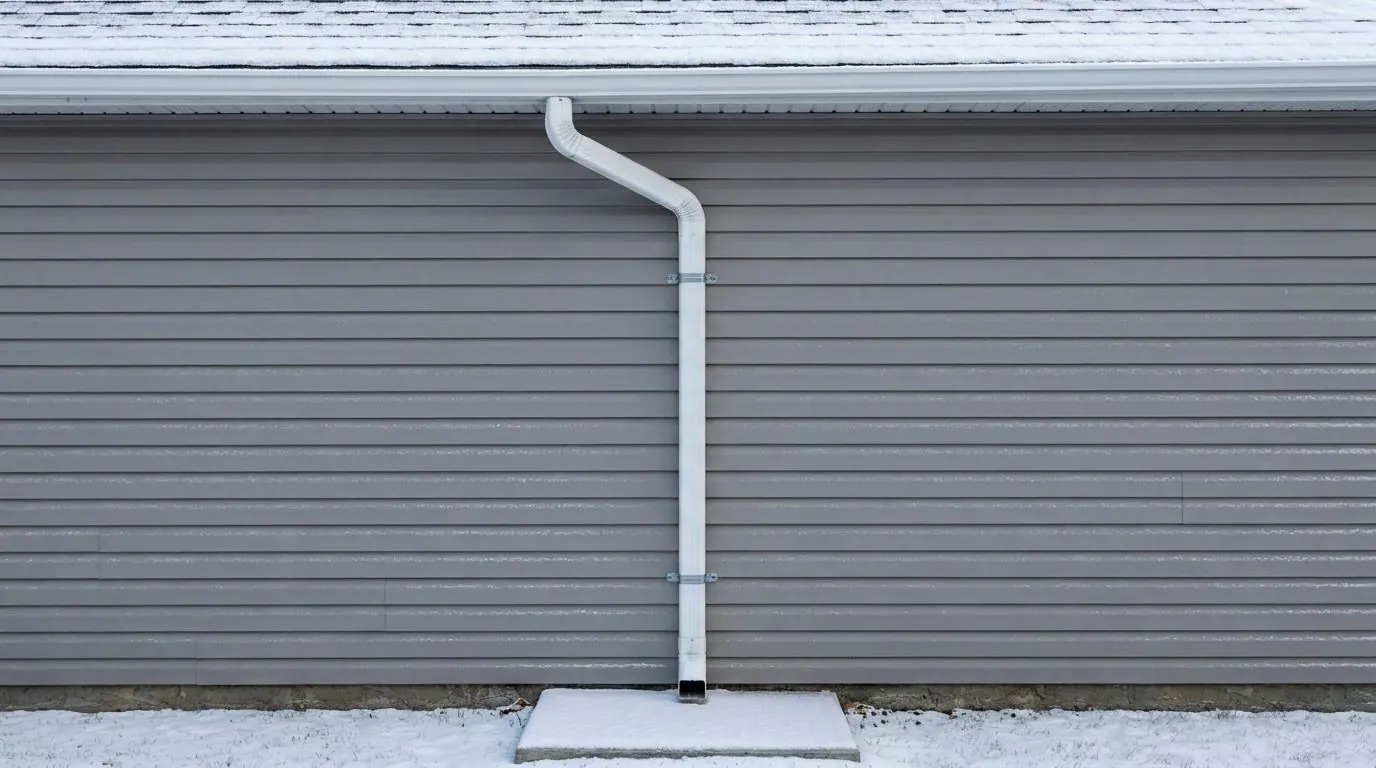
The Problem It Solves
Gutters on a commercial or multi-family property fail the same way they do on a house, but the consequences multiply. A townhouse complex has dozens of downspouts discharging beside dozens of foundations, walkways and parking stalls, and one overflowing run can put ice on a shared sidewalk where residents and visitors walk every morning. A strip of commercial bays has long, low-slope roofs draining to a few outlets above doorways and loading areas. A single blocked downspout on those buildings can mean water through a unit ceiling, a slip hazard at a customer entrance or a sheet of ice across an overhead door.
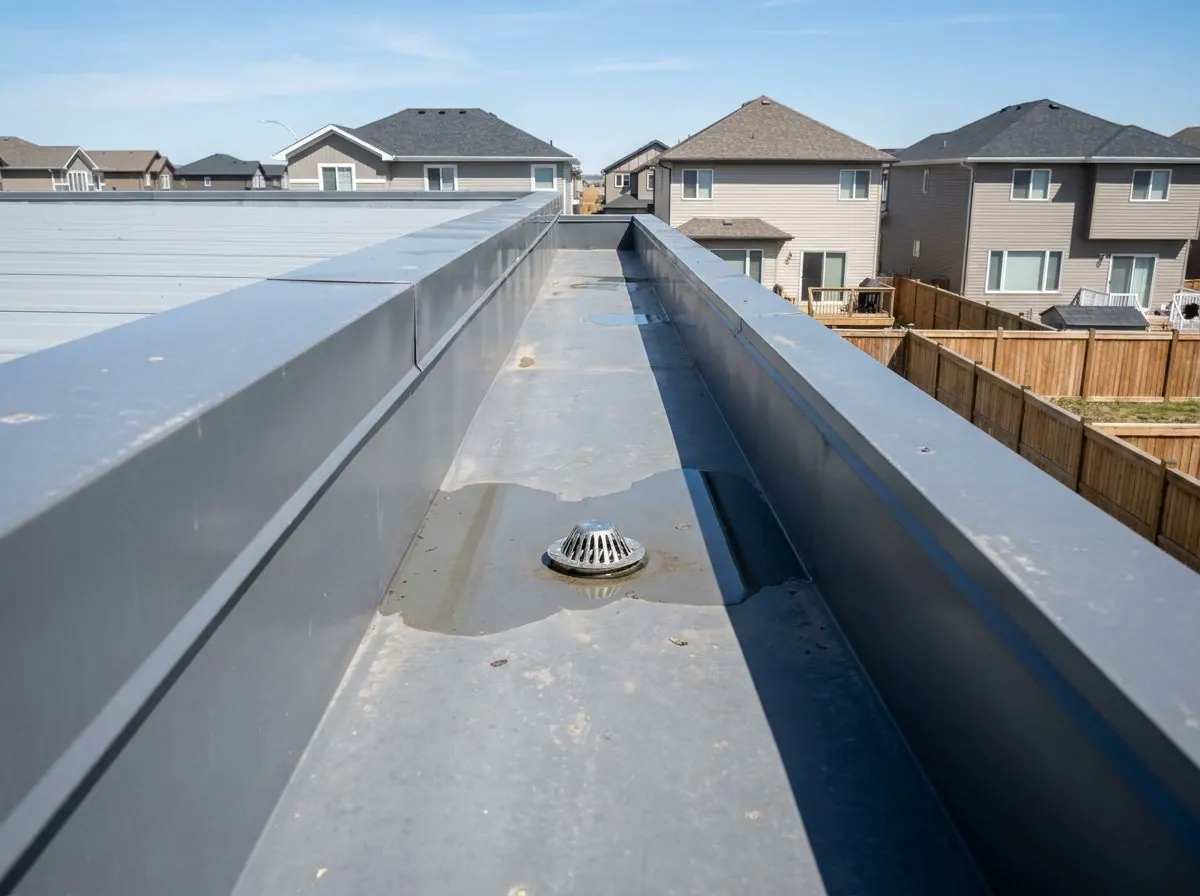
The buildings themselves are harder on eavestroughs. Commercial and agricultural roofs are larger and often much longer than residential ones, so they deliver more water to each outlet than a standard 5" residential gutter and 2x3" downspout were designed to carry. Built-in box gutters on older commercial buildings hide their leaks inside the wall or roof structure until the damage shows up indoors. Steel-roofed shops and farm buildings shed their snow load in one slide, which tears conventional gutters and hangers straight off the eave. Hail, which the Calgary–Airdrie corridor sees more of than most of Canada, leaves long runs dented and split.
Then there is the management problem. Boards and property managers rarely have a clear record of which buildings were cleaned, which downspouts were repaired, or which complaints were fixed rather than just closed. Maintenance happens after a leak rather than before one, contractors change from year to year, and residents are left wondering why the same corner overflows every spring. Without a schedule and a written report, a gutter system across a whole property slowly degrades one run at a time, and repairs end up more expensive and more disruptive than planned maintenance would have been.
How It Works
We approach a commercial or multi-family property as a system to be surveyed, specified and maintained, not a string of service calls. The first step is a walk of the whole property with a building-by-building inventory: roof areas, gutter profiles, outlet sizes, downspout discharge points, damage and known trouble spots. From that we separate what needs repair now, what should be upgraded when budget allows, and what simply needs regular cleaning, so a board or owner can plan work in a sensible order.
For new work and replacement, we size the system to the building. Long commercial runs and large roof areas typically get 6" seamless K-style or larger profiles in heavy-gauge coil, paired with 3x4" or larger downspouts and protected lower sections where vehicles and carts pass. Box gutters are assessed for relining or replacement, with the owner's roofer involved where the gutter is part of the roof assembly. On steel roofs, eavestroughs go below the snow slide path or are paired with snow guards so a winter slide doesn't take them off. Discharge is routed away from walkways, entrances and neighbouring lots.
For ongoing care, we set up a scheduled maintenance program: typically a spring and fall visit to clean, flush and inspect, with a written report noting what was done on each building, photos of anything needing attention, and recommendations ranked by urgency. Residents and tenants are given notice before work starts, lifts and ladders are placed to keep entrances and fire lanes open, and the property manager has one record to point to. The result is fewer emergency calls, predictable spending and a paper trail that answers the next owner's question.
How the Job Runs, Step by Step
Property survey and inventory
We walk every building and record roof areas, gutter profiles, outlet and downspout sizes, discharge points and visible damage on a site plan. Known complaints from residents or tenants are checked on the spot so they are either confirmed or cleared.
Prioritized scope for the board or owner
We present findings as three lists: urgent repairs, recommended upgrades and routine maintenance, each tied to specific buildings. That lets a condo board vote on a budget or an owner phase work around operations without guessing what matters most.
Access, notice and site safety plan
We plan lift placement, roof access, parking and pedestrian protection before arriving, and give the manager notice text for residents or tenants. Work at height uses fall protection in line with Alberta OHS requirements, and fire lanes and entrances stay usable.
Install, repair or reline
We carry out the approved work: seamless 6" or larger runs formed on site, oversized downspouts with guarded lower sections, box gutter relining, snow-slide protection on steel roofs, or repairs to seams, hangers and outlets. Each building is signed off before moving to the next.
Scheduled maintenance and reporting
On a maintenance program, we return on the agreed schedule, usually spring and fall, to clean, flush and inspect every run. Each visit ends with a written, building-by-building report and photos, so the board or manager sees what was done and what is coming up.
What Decides the Specification
Roof size and shape decide the gutter and downspout specification. A commercial roof delivers far more water per outlet than a house, and low-slope or long roofs concentrate it further, so capacity comes from a larger profile, more outlets and downspouts sized to match rather than from hoping a residential system keeps up. Heavy-gauge .032" aluminum resists ladder damage, hail and snow load better on long spans, and prefinished steel is an option where extra stiffness is wanted, with the trade-off that scratches and cut edges need attention so they don't rust.
The site decides the rest. Downspouts beside parking stalls, carts or farm equipment need protected lower sections or boot guards. Entrances and overhead doors should not sit under an outlet or a snow slide path. Steel roofs on shops and agricultural buildings need gutters placed below the slide path or paired with snow guards, because hangers alone won't hold a roof avalanche. On complexes, colour matching across many buildings and consistent parts matter for appearance and for making future repairs simple. Access, whether by lift, roof hatch or ladder, affects scheduling more than material choice does.
Code, Bylaw and Manufacturer Notes
Commercial work may need a building permit where replacing an eavestrough on a house generally does not, and requirements differ between the City of Airdrie, Rocky View County, Crossfield, Irricana, Cochrane and Calgary, so we check with the municipality for each property. Discharge on Airdrie properties follows the City of Airdrie's drainage bylaw: downspouts must direct water away from the building, must not discharge onto adjacent property or onto external stairs, landings or walkways, and should be at least two metres from a swale. Downspouts are never connected to the sanitary sewer.
Work at height on commercial and multi-family buildings is done with fall protection in line with Alberta Occupational Health and Safety requirements. Where a condo corporation or property owner has its own contractor safety or insurance requirements, we work within them. Box gutter repairs that involve the roof membrane are coordinated with the building's roofer so the roof assembly stays watertight.
General guidance only. The municipality, its bylaws and the manufacturer’s installation instructions decide what applies to your job.
Around Airdrie
Airdrie's 2010s-onward growth in areas such as Midtown and Ravenswood includes attached and multi-family housing, and complexes like these are typically managed by condo boards or property management firms, with rows of attached units that share long eavestrough runs, downspouts discharging between garages, and walkways that ice up quickly under an overflowing outlet during chinook melts. Those sites benefit most from a scheduled program, because a single missed spring cleaning can affect many households at once.
South of the city, Balzac's commercial and industrial bays have long low-slope roofs, overhead doors and truck traffic, where downspout protection and discharge away from loading areas matter as much as capacity. Out in Rocky View County, and around Irricana and Crossfield, agricultural buildings, shops and equipment sheds are commonly steel-roofed, so snow slides and hail are the main threats to eavestroughs. For those properties we plan around the slide path first, then around where the collected water can go without softening a yard or driveway, checking the local rules with the county or town.
Often Done Alongside
6-Inch High-Capacity Commercial & Residential Gutters
6" seamless gutters and 3x4 downspouts for big, steep or complex roofs.
Oversized 3x4 Inch Commercial Downspouts
3x4 downspouts with double the opening of a 2x3, for busy roofs and commercial runs.
Gutter Cleaning & Downspout Flushing
Hand-scooped troughs, flushed downspouts, augered elbows and a written report.
Where We Do This Work
Commercial & Multi-Family: Questions We Get
Can you set up a gutter maintenance schedule for our condo board?
Do you repair built-in box gutters on older commercial buildings?
Why do gutters keep tearing off our steel-roofed shop?
How do you work around residents, tenants and traffic?
Can eavestroughs be installed in an Airdrie winter?
Considering Commercial & Multi-Family?
Call Airdrie Gutters or send the details. We will look at the job, tell you whether commercial & multi-family is the right fix, and price it in writing.