Copper, Zinc & Specialty Metal Gutters for Airdrie Custom Homes
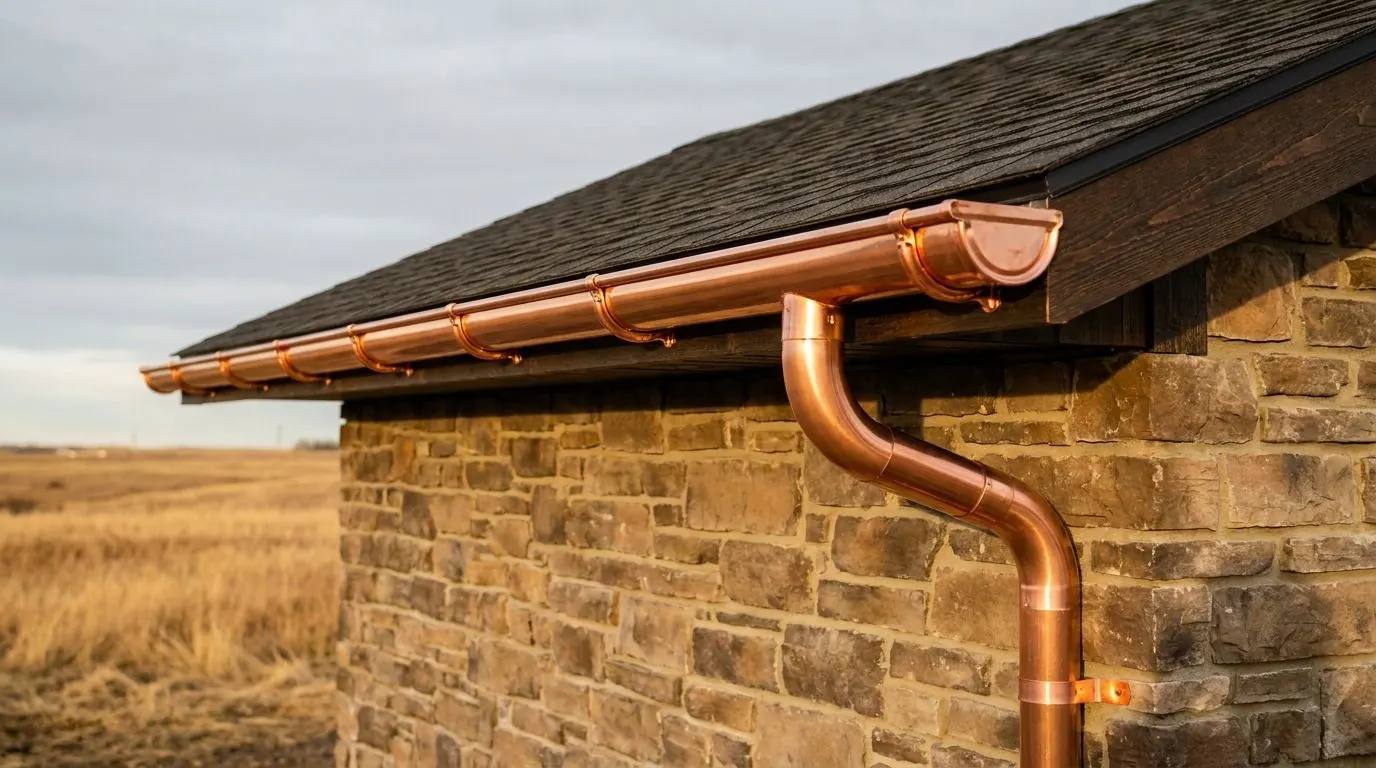
For luxury custom and heritage-style homes, the gutter is part of the architecture. We install copper in 16 or 20 oz weights, zinc and painted steel, half-round or K-style, with soldered seams and fastening chosen so dissimilar metals never touch.
The Problem It Solves
On a custom home, standard pre-painted aluminum eavestrough can look like an afterthought. The house may have stone, timber, standing-seam metal roofing or a heritage-style facade, and a white or brown K-style trough runs across all of it like a line of trim nobody chose. Owners who spent months on exterior materials often don't think about the gutters until they're on, and by then the roofline reads as builder-standard. Replacing it later means removing and re-hanging the whole system around finished masonry and trim.
The bigger problem with specialty metals is what happens when they're installed as if they were aluminum. Copper trough gets hung on galvanized hangers or fastened with steel screws, and within a few seasons the contact points corrode. Copper downspouts get connected to an existing aluminum elbow at grade. Painted steel gets cut on site and the raw edges are left bare. Each of these is a small shortcut, and each turns an expensive, long-lived material into a system that stains, corrodes at the fasteners, or rusts from the cut edges long before the metal itself should have worn out.
Airdrie's climate makes those mistakes show up faster. Chinook freeze–thaw cycles work every joint and fastener repeatedly through the winter, and a soldered seam that wasn't cleaned and fluxed properly will crack under that movement. Hail can dent softer copper on exposed runs. Runoff from copper carries dissolved metal that leaves green-blue staining on light stucco, stone, concrete patios and wood decks below, which is very hard to remove from porous surfaces. None of these are reasons to avoid specialty metal; they're reasons to specify and install it with those conditions in mind.
How It Works
We treat a specialty metal system as its own trade rather than a colour option. For copper, that starts with choosing 16 oz or 20 oz sheet: 20 oz is heavier, stiffer and better at resisting dents and holding shape over long runs, while 16 oz suits smaller runs and sheltered elevations. We pair the trough with copper hangers, copper or other compatible fasteners, and copper downspouts and elbows, so no aluminum or galvanized steel touches the copper anywhere in the water path or the fastening.
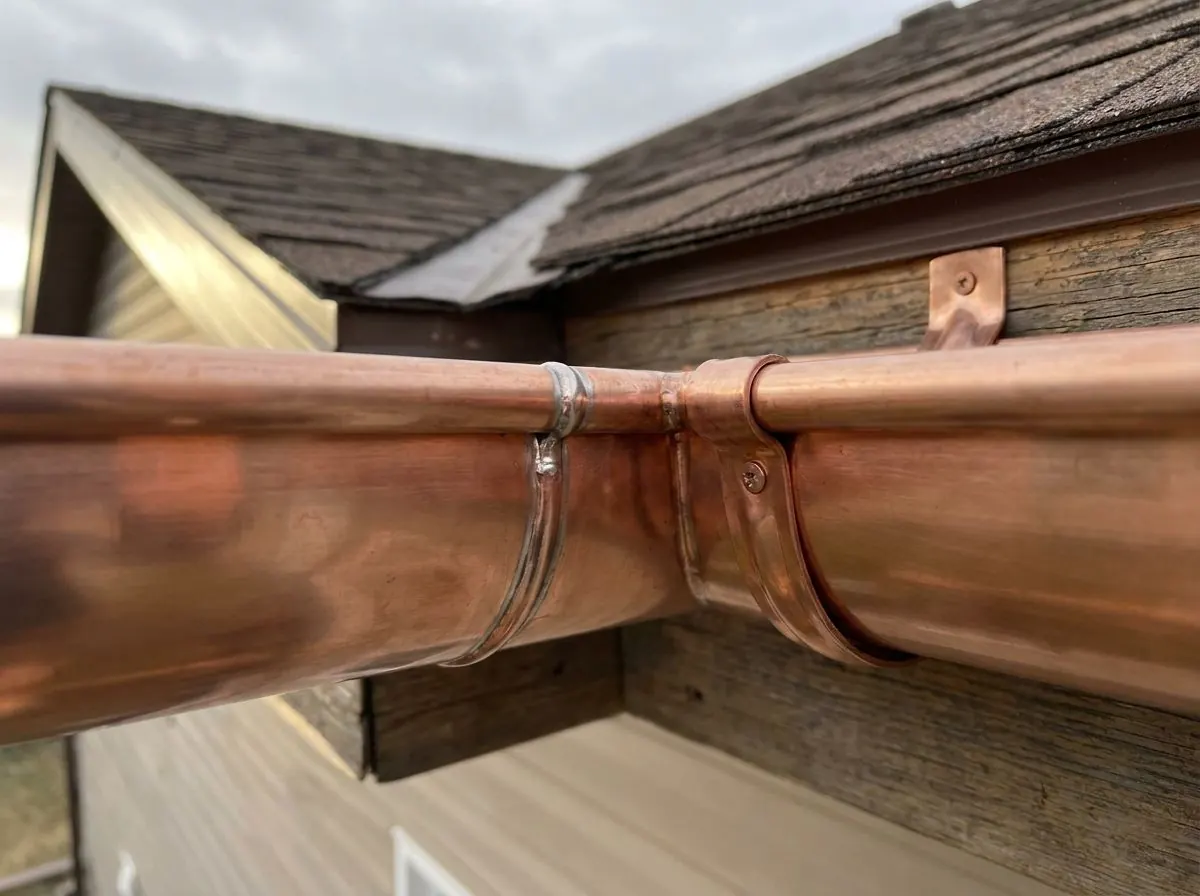
Profile follows the architecture. Half-round copper suits heritage, craftsman and many timber-frame designs; it comes in sections joined with soldered lap seams and pairs with round downspouts. Where a homeowner wants the copper look with a flat-backed profile, K-style copper can be roll-formed seamless like aluminum, leaving soldered or sealed seams only at corners and end caps. Zinc is usually installed as a soldered system and develops a grey protective patina. Painted steel offers colours that aluminum doesn't, with more stiffness, provided every cut edge and scratch is treated.
The result is a gutter system that belongs to the house. Soldered seams that are cleaned, fluxed and fully flowed hold through repeated freeze–thaw movement instead of relying on sealant alone. Isolated fastening means the metal weathers on its own terms instead of corroding at every hanger. And because we plan where the downspouts discharge, copper runoff goes to gravel, drains or dark surfaces instead of staining the pale stone entry you paid for.
How the Job Runs, Step by Step
Review the architecture and exposure
We walk the house with you and look at the roofing material, fascia profile, trim and facade surfaces below each run. We note which elevations face open ground and take hail, and where runoff will land. That decides the metal, the weight, the profile and where downspouts can go without staining finished surfaces.
Specify metal, weight and compatible components
We set out the full component list in one metal family: trough, hangers, fasteners, outlets, downspouts, elbows and straps. Where a specialty gutter meets existing aluminum flashing or a galvanized component, we plan a separator or a compatible transition so the dissimilar metals never touch.
Fabricate sections, corners and outlets
Half-round sections are measured and cut, and corners, end caps and outlets are fabricated for soldering. K-style copper is roll-formed to length where the run allows. We pre-fit pieces on the ground so solder joints are made on clean, well-supported metal rather than stretched into place overhead.
Hang, solder and pitch the system
Hangers are set into solid wood at close spacing and the trough is hung to a measured slope. Lap seams, corners and outlets are cleaned, fluxed and soldered so the solder flows fully through the joint. Flux residue is cleaned off afterwards, since leftover flux can mark the metal as it weathers.
Fit downspouts and plan runoff surfaces
Round or rectangular downspouts are fitted with matching elbows and straps. Each discharge is directed onto gravel, a splash block or a drain rather than light stone or concrete. We run water through every run to check the soldered joints and confirm each downspout drains cleanly.
What Decides the Specification
Metal choice comes down to appearance, exposure and how the owner wants the gutter to age. Copper starts bright, turns brown and, over a long period that depends heavily on exposure, moves toward the green patina associated with older buildings. Zinc dulls to a grey protective patina and suits modern and European-style exteriors. Painted steel holds a chosen colour and is stiffer than aluminum on long spans, but it depends on its coating, so cut edges and scratches need treating. We help owners compare how each will look on their house after several winters, not just on install day.
Within copper, weight is the main decision. Twenty-ounce copper, about the same thickness as standard .027" aluminum coil but far heavier and more rigid, handles hail, long runs and ice load better. Sixteen-ounce copper, about .0216", is lighter and suits shorter runs and sheltered elevations. Profile and downspout shape follow the architecture, and fastening follows the metal: copper hangers or compatible fasteners throughout, with separators wherever the system has to meet existing aluminum or galvanized steel. That compatibility rule is non-negotiable, because galvanic corrosion at a hanger undermines the whole system.
Code, Bylaw and Manufacturer Notes
Gutter replacement on an existing home generally doesn't require a building permit in Alberta, while new custom construction is permitted as a whole; check with the municipality, whether that is the City of Airdrie, the Town of Cochrane or Rocky View County. Where specialty gutters are installed alongside new roofing, the roofing work has its own requirements, including eave protection membrane under the shingles in most cases and drip edge as called for by shingle manufacturers' instructions. Metal roofing and specialty flashing have manufacturer requirements for compatible metals, and we follow them at every connection between gutter and roof edge.
Discharge rules still apply to premium systems. In Airdrie, the drainage bylaw (B-03/2014) requires that downspouts not discharge onto adjacent property or walkways, sit at least two metres from a swale and not end within two metres of the property line. For acreage and hillside properties, check drainage requirements with Rocky View County or the Town of Cochrane. On any property, roof water from a copper or zinc system goes to grade, a splash block or an approved drain, never into the sanitary sewer.
General guidance only. The municipality, its bylaws and the manufacturer’s installation instructions decide what applies to your job.
Around Airdrie
Most specialty metal work around Airdrie is on custom homes rather than in subdivisions. On the hillsides around Cochrane, houses built to take in the mountain view often use timber, stone and steep, complex roofs, and a half-round copper system with round downspouts suits that architecture far better than painted aluminum. Those same sites are exposed. Hillside lots catch more wind than a sheltered subdivision street, and the whole region sits in a hail-prone corridor, which is why we usually recommend 20 oz copper on the exposed side and careful attention to where runoff crosses stone patios and retaining walls.
Acreage builds in Rocky View County bring long eaves, detached shops and often standing-seam metal roofing, where zinc or painted steel can match the roof and hold up to open-prairie weather. Inside Airdrie, the larger golf-course-era homes in Woodside are the kind of house where copper accents can suit: copper trough and downspouts on the front elevation, or on a bay window or entry roof, with matched aluminum on the less visible sides. That split approach works well, provided the transition between metals is properly isolated.
Often Done Alongside
Heavy-Duty Hidden Hanger Fastening Systems
Hidden hangers 12–18" apart, screwed into solid wood to carry ice and snow.
Aluminum Drip Edge Flashing
Eave and rake drip edge, including retrofits under existing shingles.
6-Inch High-Capacity Commercial & Residential Gutters
6" seamless gutters and 3x4 downspouts for big, steep or complex roofs.
Where We Do This Work
Copper & Specialty Metal: Questions We Get
How long does copper take to turn green?
Is 16 oz or 20 oz copper better for Airdrie hail?
Can copper gutters connect to my existing aluminum downspouts?
What is the difference between zinc and painted steel gutters?
Do I need a permit to replace eavestroughs, soffit or fascia?
Considering Copper & Specialty Metal?
Call Airdrie Gutters or send the details. We will look at the job, tell you whether copper & specialty metal is the right fix, and price it in writing.