Heavy-Gauge Aluminum Fascia Capping for Airdrie Homes
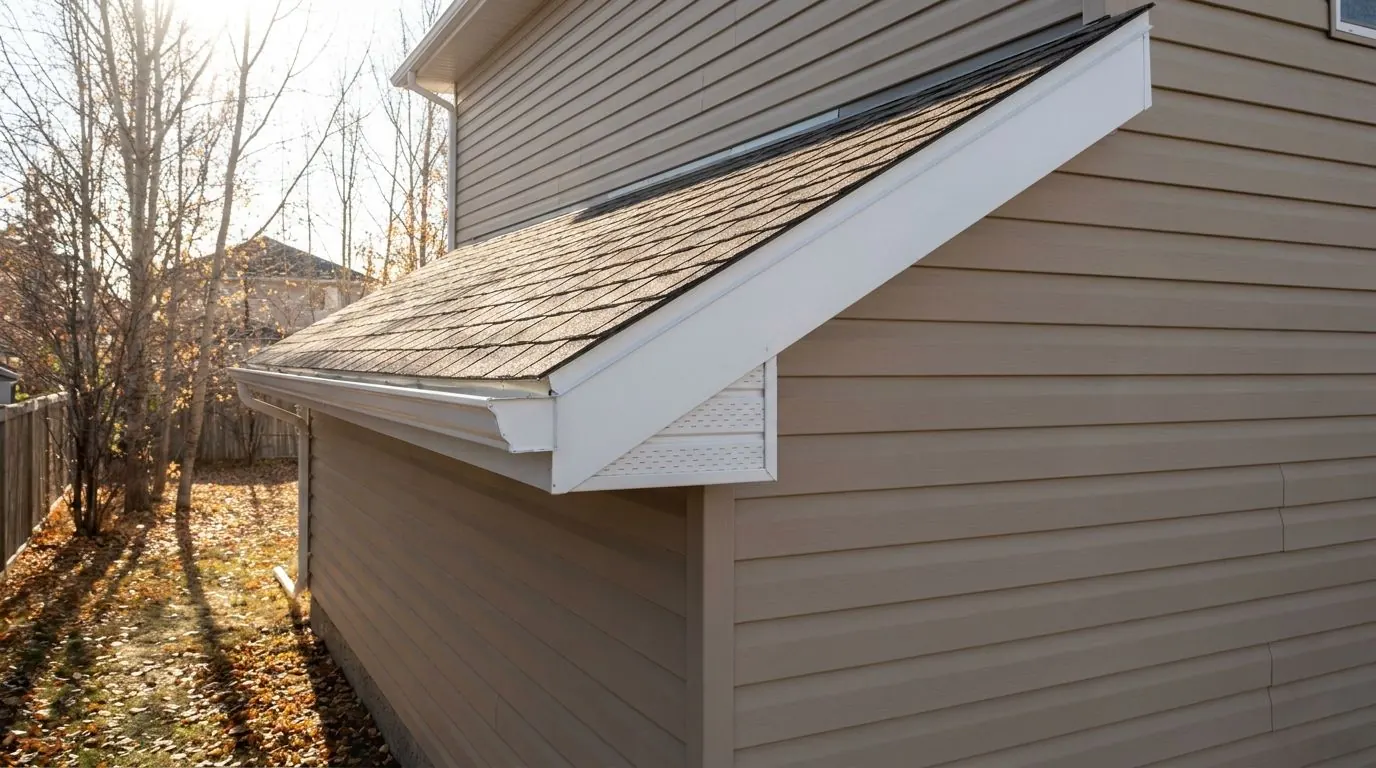
Painted wood fascia takes the worst of the sun, roof runoff and Chinook freeze–thaw on your house. We wrap sound fascia boards in heavy-gauge prefinished aluminum, bent on site to fit, tucked under the drip edge and sealed at the ends so the wood stays dry.
The Problem It Solves
Fascia is the board fastened across the ends of your rafters or trusses, the one your eavestrough hangs from, and on a great many houses it is painted wood. Paint on fascia has the hardest life of any trim on a home. It faces south and west sun at a steep angle, catches every drip that comes off the roof edge, gets splashed whenever a trough overflows, and sits against packed snow and ice for weeks at a time. Once the paint film cracks, bare wood drinks in water, swells and pushes the next coat off faster, so repainting from a ladder above the eaves becomes a chore that comes around again far sooner than anyone expects.
The bigger issue is what failed paint lets happen underneath. Wet wood at the top edge of the fascia wicks moisture toward the roof deck and back into the sub-fascia and rafter tails. Hanger screws driven into a damp board lose their grip as the wood swells, shrinks and freezes, and an eavestrough that pulls even slightly away from its board starts spilling water down the back of itself, which soaks the fascia further. It is a feedback loop, and Airdrie’s Chinook winters, with thaw after thaw followed by hard refreezes, run that loop many more times per season than a steady cold climate would.
There is the plain question of appearance too. Faded, peeling or blotchy fascia makes a house look tired no matter how new the roof or siding is, and it is the line people notice first because it frames the whole roof. The contrast is worst right after new eavestroughs go up: a crisp prefinished trough hanging on a weathered board makes the old paint look even more worn. Hail seasons add chips and dents to wood trim that paint alone can’t hide.
How It Works
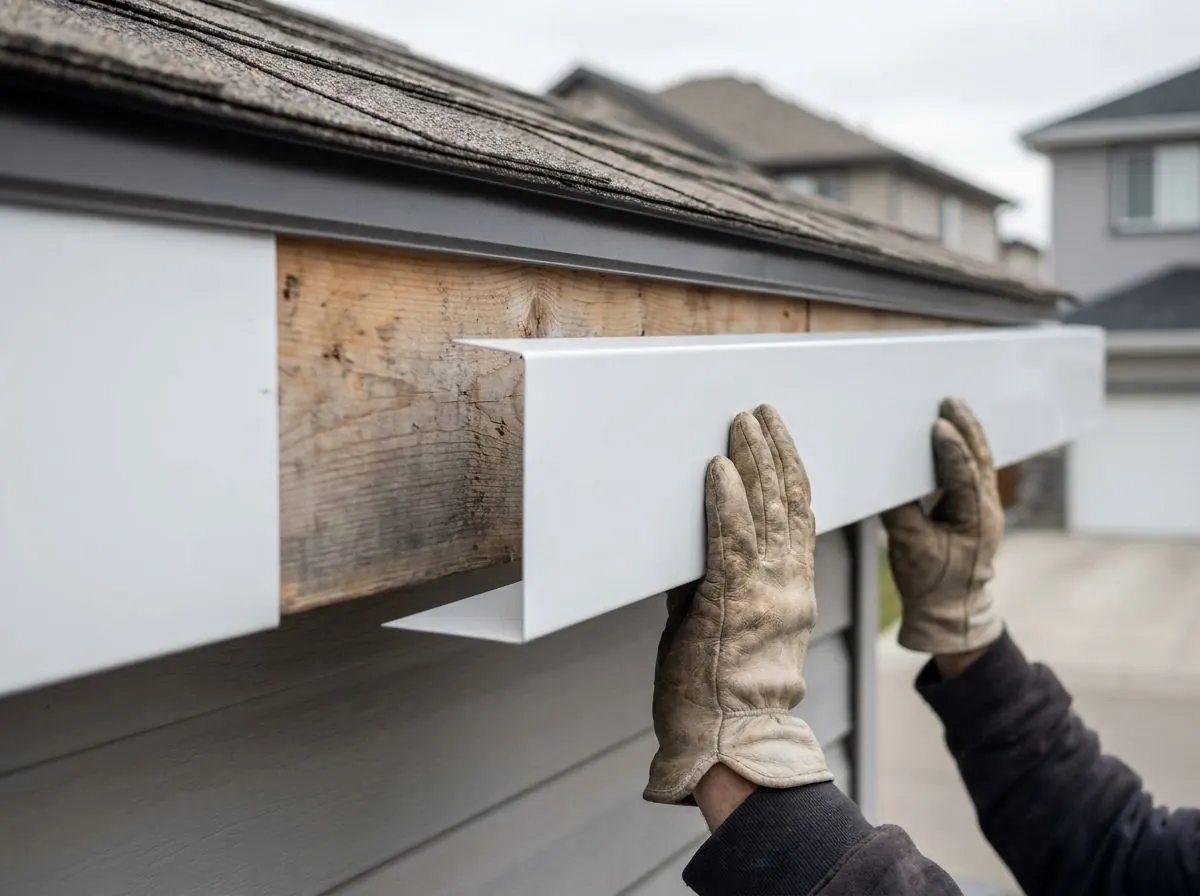
Fascia capping wraps the wood board in prefinished aluminum coil, bent on a brake into a profile that matches your fascia exactly: a face, a top leg and a bottom return. Because it is formed on site from flat coil, every run fits the real face height of your boards, including the odd sizes found on additions and older rooflines, rather than forcing a one-size piece to fit. The colour is baked on at the factory, so there is nothing to scrape or repaint, and it can be matched to your soffit and eavestrough so the roof edge reads as one clean band.
How the capping laps is as important as the metal itself. At the top, the capping’s upper leg tucks up under the roof’s drip edge, so water coming off the shingles lands on the outside face of the aluminum and never gets a path behind it. At the bottom, the return laps over the soffit edge, locking that joint. The eavestrough then mounts over the capping, with its hidden hangers screwed through the aluminum into solid wood. Where one length meets the next, the pieces overlap in the direction water travels, and at gable returns, outside corners and the points where fascia dies into a wall, the ends are folded and sealed so wind-driven rain can’t get in behind. Closed, sealed ends also stop wasps and birds nesting in the gap behind the metal, so the wrap guards the board against rot, moisture and pest nesting together.
Capping is a protective skin, not a repair, and we are straightforward about that. It only works over sound wood, because the eavestrough hangers need something solid to bite into and because aluminum wrapped over rot simply hides the damage while it spreads. When we find soft fascia, sub-fascia or rafter tails, that section is replaced first through our rotted trim restoration service, and then the new wood is capped like the rest. The result is a fascia that stays dry, holds screws, keeps its colour and never needs another ladder-top paint job.
How the Job Runs, Step by Step
Probe every fascia run and read the roof edge
Before measuring for metal, we probe the fascia along each run with an awl, concentrating on downspout outlet locations, inside corners and anywhere old overflow has stained the paint. We also check whether the roof has a drip edge and whether its face reaches far enough down to cover the capping’s top leg. Those two findings decide whether the job is straight capping or needs carpentry or flashing first.
Plan around the eavestrough
Capping sits behind the trough, so existing eavestroughs have to come down, or the work is scheduled together with a new eavestrough installation. We record outlet positions and hanger spacing before anything is removed so the system goes back up at the correct slope. If the old troughs are too worn to rehang, we tell you before they come off, not after.
Measure and bend on the brake
The coil is set up on a portable brake at the house, and each run is measured for face height, top leg and bottom return. Lengths are bent with hemmed or folded edges where needed for stiffness and a straight visual line. Pieces for corners and gable returns are formed to suit the actual angles on your roof rather than assumed to be square.
Fit, lap and fasten with room to move
The top leg slides up under the drip edge, the bottom return laps over the soffit, and joints overlap with the flow of water. Fasteners are colour-matched and placed so they don’t dimple the face, and long runs are fastened to allow aluminum to expand and contract through big temperature swings. That movement allowance is what keeps capping from rippling on a hot afternoon.
Seal ends, rehang and inspect
Open ends at gable returns and wall intersections are folded closed and sealed with an exterior-grade sealant. The eavestrough is then rehung over the capping with hanger screws reaching solid wood, and its slope is checked again. We finish with a walk around the house to confirm every lap sheds water outward and no raw edge is facing the weather.
What Decides the Specification
The metal is prefinished aluminum trim coil in a heavy gauge, commonly about .019" to .024". Heavier coil holds a straighter line across a long fascia run, shows less waviness in low sun, and resists dents from hail and ladder feet better than light trim stock, which matters on a house that will have eavestroughs cleaned and serviced from a ladder for decades. Aluminum does not rust, and the baked-on finish holds its colour far longer than site-applied paint on wood. Colour choice is usually made alongside the eavestrough and soffit so all three match or contrast on purpose, not by accident.
The rest of the specification comes from the roof edge itself. Board face height and whether there is a separate trim or crown detail set the bend profile. Whether a drip edge exists, and how far its face reaches, decides whether the top leg can be properly tucked; where there is no drip edge or it is too short to cover the capping, adding one is the right move and is covered on our drip edge flashing page. Long uninterrupted runs, complex hips and bump-outs, and the number of gable returns affect how many laps and sealed ends a job needs. Whether the eavestroughs are being replaced at the same time decides the scheduling and whether the fascia is ever fully exposed.
Code, Bylaw and Manufacturer Notes
Capping sound fascia on an existing house is exterior trim work and generally does not need a building permit, but replacing structural fascia, rafter tails or truss ends, or doing the work on a commercial or multi-family building, may bring other requirements. Check with the City of Airdrie, or with Rocky View County, Cochrane, Crossfield or the City of Calgary where the property falls under them, before larger repairs. The roof edge itself is governed by the shingle manufacturer’s installation instructions, so we detail capping to work under the existing drip edge rather than lifting shingles out of their intended order.
General guidance only. The municipality, its bylaws and the manufacturer’s installation instructions decide what applies to your job.
Around Airdrie
Woodside grew up around the golf course through the 1990s and 2000s, and it is common for homes of that era to still carry the painted wood fascia they were built with, often on wider boards and more detailed rooflines than newer subdivisions use. After that many Chinook winters and summers of hard sun, those boards have reached the point where owners either repaint every few seasons or cover them for good. The mature trees along the fairways also mean more overflowing troughs and more water down the face of the fascia, which speeds up paint failure and makes a careful probe for soft spots before capping especially important there.
Sagewood is largely a 2000s and 2010s neighbourhood, and houses of that age commonly have painted fascia and first-generation eavestroughs reaching replacement age together. That combination makes the eavestrough replacement the efficient moment to cap: the troughs are already coming down, the full board is exposed, and the new colour can be chosen to match both. We cap fascia the same way across the rest of Airdrie and in Cochrane, Crossfield and north Calgary.
Often Done Alongside
Soffit Rot & Fascia Board Restoration
Replace rotted fascia, rafter tails and soffit wood before new trim goes on.
Aluminum Drip Edge Flashing
Eave and rake drip edge, including retrofits under existing shingles.
Vented & Solid Aluminum Soffit Installation
Vented and solid aluminum soffit that restores attic intake and keeps pests out.
Where We Do This Work
Fascia Capping: Questions We Get
Do the eavestroughs have to come down to install fascia capping?
Why bend capping on site instead of using pre-formed fascia pieces?
Why does aluminum fascia on some houses look wavy?
Will capping stop water from getting behind my eavestrough?
How do you work out what my eavestroughs actually need?
Considering Fascia Capping?
Call Airdrie Gutters or send the details. We will look at the job, tell you whether fascia capping is the right fix, and price it in writing.